

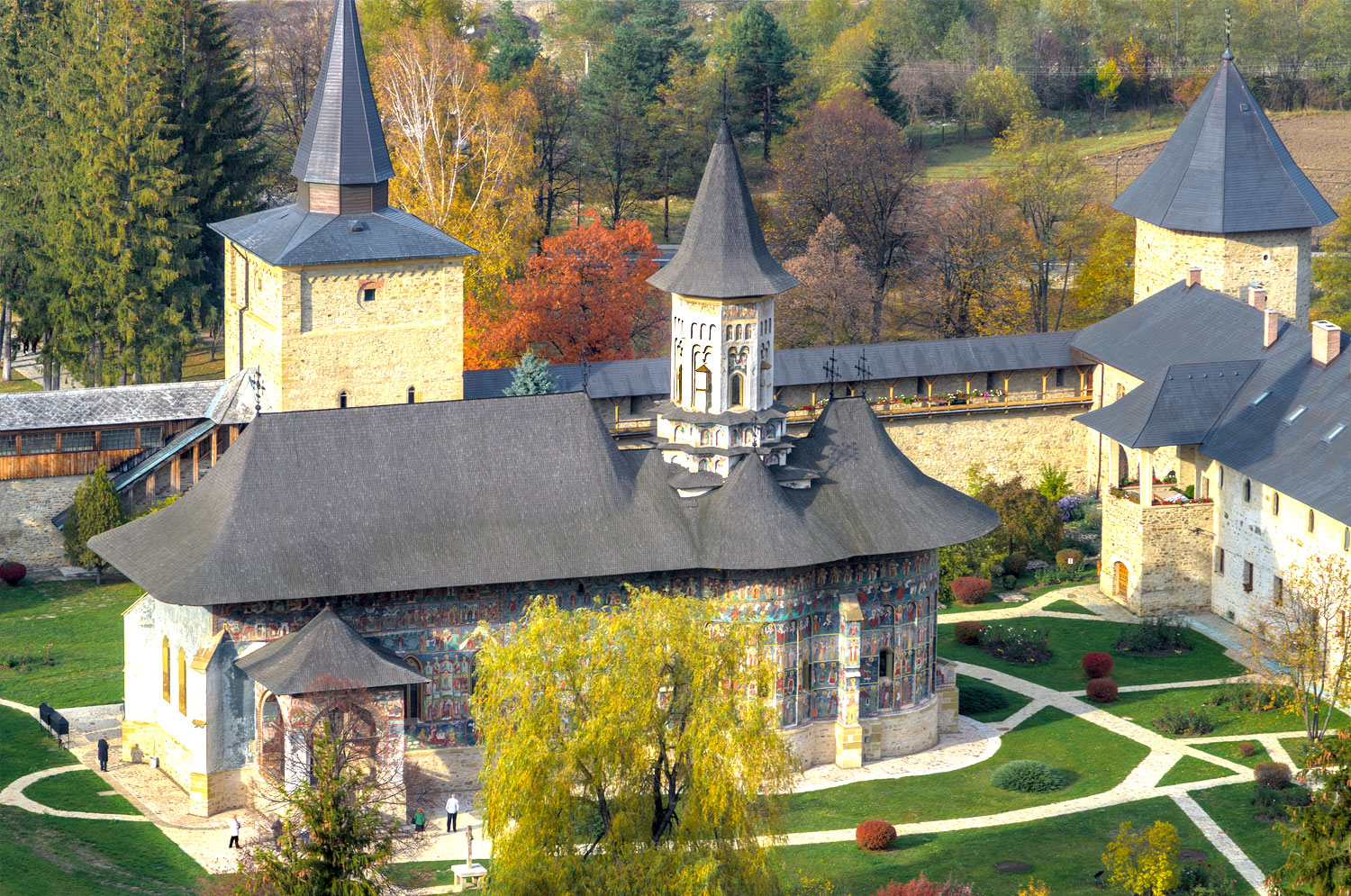
Location: Bucovina region – northeastern Romania
Nearby large town: Radauti (12 miles east), Gura Humorului (32 miles south) and Suceava (33 miles east)
Access: car, bus (from Radauti)
Nearest train stations: Radauti, Vatra Moldovitei hc
High walls and heavily buttressed defensive towers surround the great monastic complex of Sucevita, giving it the appearance of a fortress. Founded in 1581 by Gheorghe Movila, Bishop of Radauti, it was later expanded by his brother, Ieremia, ruling prince of Moldavia, who added massive ramparts and turrets. An elegant steeple resting on a star-shaped base tops the church. Massive eaves protect the outside frescoes, painted by local artists in 1602-1604.
Sucevita boasts a magnificent depiction of the Ladder to Paradise.
Red-winged angels in orderly rows attend the righteous on a slanting ladder to the heavens, each rung inscribed with one of the monastic virtues.
Sinners fall through the rungs and are driven by grinning devils to the chaos of hell.
On the south side, foliage entwines the rows of figures in the Tree of Jesse. Following it is the Hymn to the Virgin.
While the exterior frescoes are the most famous feature, the interior of Sucevița Monastery is equally stunning.
The walls are adorned with intricate frescoes depicting biblical scenes, saints, and moments from Christian history,
similar to the exterior but in a more intimate setting.
The church's main altar and iconostasis are beautifully crafted, featuring rich wood carvings and gilded icons.
The monastery also houses a collection of valuable manuscripts, religious artifacts, and embroidered vestments,
offering a deeper insight into its spiritual and cultural significance.
A unique blend of Byzantine, Gothic, and Moldovan styles monastery Sucevita is a truly mesmerizing place inside and out.
Sucevita was a princely residence as well as a fortified monastery. Today, the thick walls shelter a museum presenting an outstanding collection of historical and art objects. The tomb covers of Ieremia and Simion Movila – rich portraits embroidered in silver thread – together with ecclesiastical silverware, books and illuminated manuscripts, offer an eloquent testimony to Sucevita's importance first as a manuscript workshop, then as a printing center.
Interesting facts:
» Sucevita was the last of the 22 painted churches of Bucovina and has the largest number of painted images.
» The western exterior wall of the church is not painted.
Legend has it that work stopped after one of the painters fell from the scaffolding and died.
Hours:
Monday -- Friday: 9 a.m. – 9 p.m. (monastery), 9 a.m. – 5 p.m. (museum)
Saturday -- Sunday: noon - 9 p.m.
Mass / liturgical service:
7:30 a.m. – 9 a.m. (weekdays)
9:30 a.m. – noon (Saturday, Sunday and religious holidays)
Admission: 10 lei ($2.25)
Camera/ Photo fee: extra
Sucevita monastery Website
Info on other Bucovina, World Heritage, Painted Monasteries >