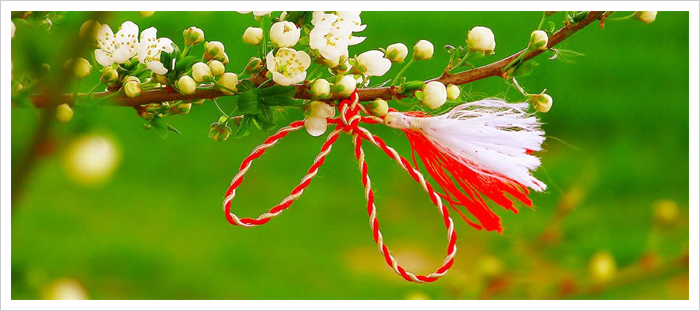


The tradition of Martisor / Mărțișor
Mărțișor
is an old tradition celebrated on March 1st, every year, all over Romania.
The name Mărțișor is a diminutive of month of March (Martie in Romanian).
The essence of the tradition consists of making/buying and offering red and white braided string/thread (mărțișor, marț or mărțiguș) to loved ones and colleagues. Often, the red and white string is tied around a small trinket. The Mărțișor will be worn until the first blossom tree, swallow or stork is seen. All members of the communities participate in this tradition, irrespective of their age.
In the old times, the Mărțișor was made of small river pebbles, colored white and red, strung on a wool thread or leather string and worn around the neck. Today, the trinket attached to the string can vary, from small symbolic hearts and four-leaf clovers to diamond-encrusted brooches. However, the Martisor is more about the symbol and less about the value of the trinket and the vast majority of people offer basic but meaningful designs.

When the Martisor tradition started
According to archaeological research, the Mărțișor traces its history more than 8,000 years ago. Some ethnologists believe that the Mărțișor celebration has Roman origins, others support the theory that it is an old Dacian tradition.
In ancient Rome, the New Year's was celebrated on the 1st of March.
March ('Martius') was named in the honor of the god
Mars.
Mars was not only the god of war but also the god of agriculture,
which contributes to the rebirth of vegetation.
The Dacians also celebrated the New Year's on the first day of March. Ample spring celebrations were consecrated to this event.
In the old times, Mărțișor were made of small river pebbles, colored in white and red, stringed on a thread and worn around the neck. They were worn, to bring good luck and good weather, from March 1 until the first trees would bloom. When the first trees were flowering the Mărțișor were hanged on tree branches.

Martisor customs
On March 1, Romanians buy silky red-white strings/threads (called șnur)
tied into a bow to which a small trinket is attached and offer them to their (female) family members,
friends and colleagues to show friendship, appreciation and respect.
There are slight variations of the Mărțișor tradition.
Signification
Martisor represent good luck and the rebirth of nature.
The red/white thread is also considered to provide symbolic protection against capricious weather
and ensure a safe passage from winter to the spring.
Usually, the Mărțișor is attached to clothing, on the left side of the chest, near the heart.
Nowadays, some girls and young women wear it as a hand bracelet.
The Mărțișor is usually offered by men to female coleagues and the special ladies in their lives. However, in Moldova region (eastern Romania), women receive and give Mărțișor from/to men.
How long the Martisor is worn?
Everyone starts wearing the string (and trinket) on March 1.
However, some will wear it for one day,
other until March 9, the day after Mothers and Ladies Day - March 8 - in Romania.
Most people will still wear the Martisor
until the see the first blooming tree of the spring.
Then, they would hang the strings from one of the branches, for good luck and good weather.
Not long ago, in the countryside, people used to celebrate the Martisor by hanging a red and white string at their the gate, window, cattle's horn and shed to protect against evil spirits and to invoke nature's regenerative power.
In eastern Romania (Moldova and Bucovina regions) the red and white string was complemented with a small - gold or silver - coin. After wearing the coin for twelve days, the women would buy fresh cheese with it, to ensure that their skin would be healthy and beautiful the entire year.
Legends related to the Martisor tradition
There are a few stories behind the Martisor tradition. The main ideas are mankind’s impatience while awaiting the coming of a new spring season as well as hope for renewal.
Grandam Dochia's (Baba Dochia) black wool miraculously becomes white
Baba Dochia - an old woman called Dochia -
is a figure in Romanian mythology, most commonly associated with the coming of spring.
Dochia lived up in the mountains.
During the winter, her home – and her soul – were quite cold
and she used to walk around wrapped up in nine coats.
She had a son, Dragobete, who married a girl of whom she did not approve.
To make her new daughter-in-law miserable,
Dochia sent her to a nearby stream to wash a big bundle of black wool.
She told her not to return until the black wool has turned white.
No matter how hard the daughter-in-law washed the wool, the color did not change.
The daughter-in-law began to cry from despair,
worrying that she would not see her husband again.
However, a mystic figure came down from the sky,
gave the girl a red flower, and told her to touch the wool with the flower.
Miraculously, the wool became white.
Happy, the girl returned home and gave her mother-in-law
the bundle of white wool and the red flower too.
When Baba Dochia saw the flower, she thought that the spring had come,
since flowers only bloom in spring.
The next day, wearing her nine coats, she left for the mountains to pick spring wildflowers.
As the weather got warmer every day, Baba Dochia left one coat behind each day.
However, on the ninth day, the weather changed, and Dochia froze on the mountain, without a coat.

photo © Margele.ro
A slightly different legend of Baba Dochia is also quite popular:
Beautiful girl overcomes impossible task
A long winter marked the year when Baba Dochia's son, Dragobete chose his wife.
And that harsh winter seemed never to end.
One day, at the end of February,
Baba Dochia asked her daughter-in-law, whom she did not like much,
to bring her a bunch of spring flowers.
The daughter-in-law left the house
without knowing where to go to find spring flowers.
On her way to the nearest forest glade, she met Mărţişor - the herald of the spring.
The herald saw that the girl was sad and asked her why.
When the daughter-in-law told Mărţişor her trouble,
Mărţişor gave her a bunch of snowdrops (flowers) to take to the old woman.
Happy, the daughter-in-law, quickly returned to Baba Dochia with the snowdrops.
When Dochia saw the flowers, she believed that spring had already arrived and
that she could take her herd of sheep or goats up to the mountains.
However, Mărţişor planned to give the old woman's
a lesson and a taste of her misery.
Nine consecutive, unusually warm days followed, and every day, the old woman took off one of her coats.
However, on the tenth day, Mărţişor brought back the cold weather
and three days of terrible frost.
As the old woman had no coats left to wear, she froze, along with her sheep, and turned into rocks.
And there, up in the mountains, they remain to this day.

Sun is kidnapped by dragon and released by young man
Another legend has it that the Sun came down to Earth as a beautiful girl.
Soon after that, a dragon kidnapped the girl and made her his prisoner.
A young, handsome, boy learned about the kidnapping and fought the dragon to save the girl.
During the fight, the boy got hurt, and several drops of his blood fell on the snow.
However, the dragon was defeated, and the Sun was released and went back to the sky.
As the sun warmed the land, the snow melted and snowdrops
- the first spring flowers to bloom - bloomed everywhere.
The color red from the thread represents the young boy’s blood
while the white represents the snowdrops (flowers).