...
Brasov Fast Facts
Name: Brașov (pronounced: Bra' shov)
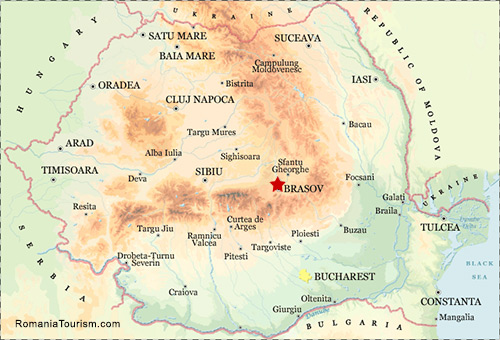
Location: Southern Transylvania
Nearest International Airport: Brașov (GHV)
Area: 28.5 sq. miles (74 sq. km)
Elevation: 2,133 ft. (650 meters)
Population: 235,000
Year Founded: 1211 AD
Oldest building: Biserica St. Bartolomeu (1223)
...
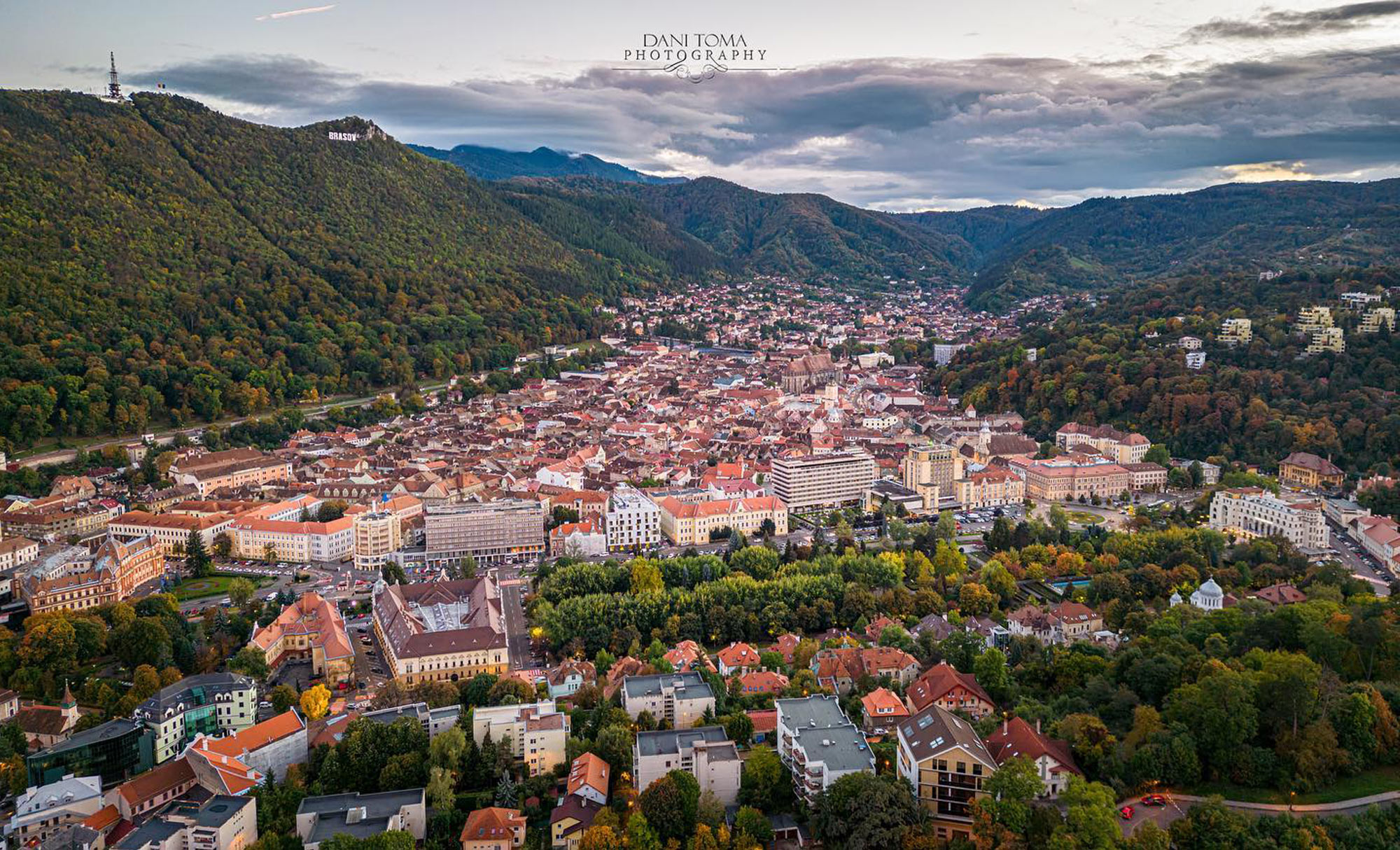
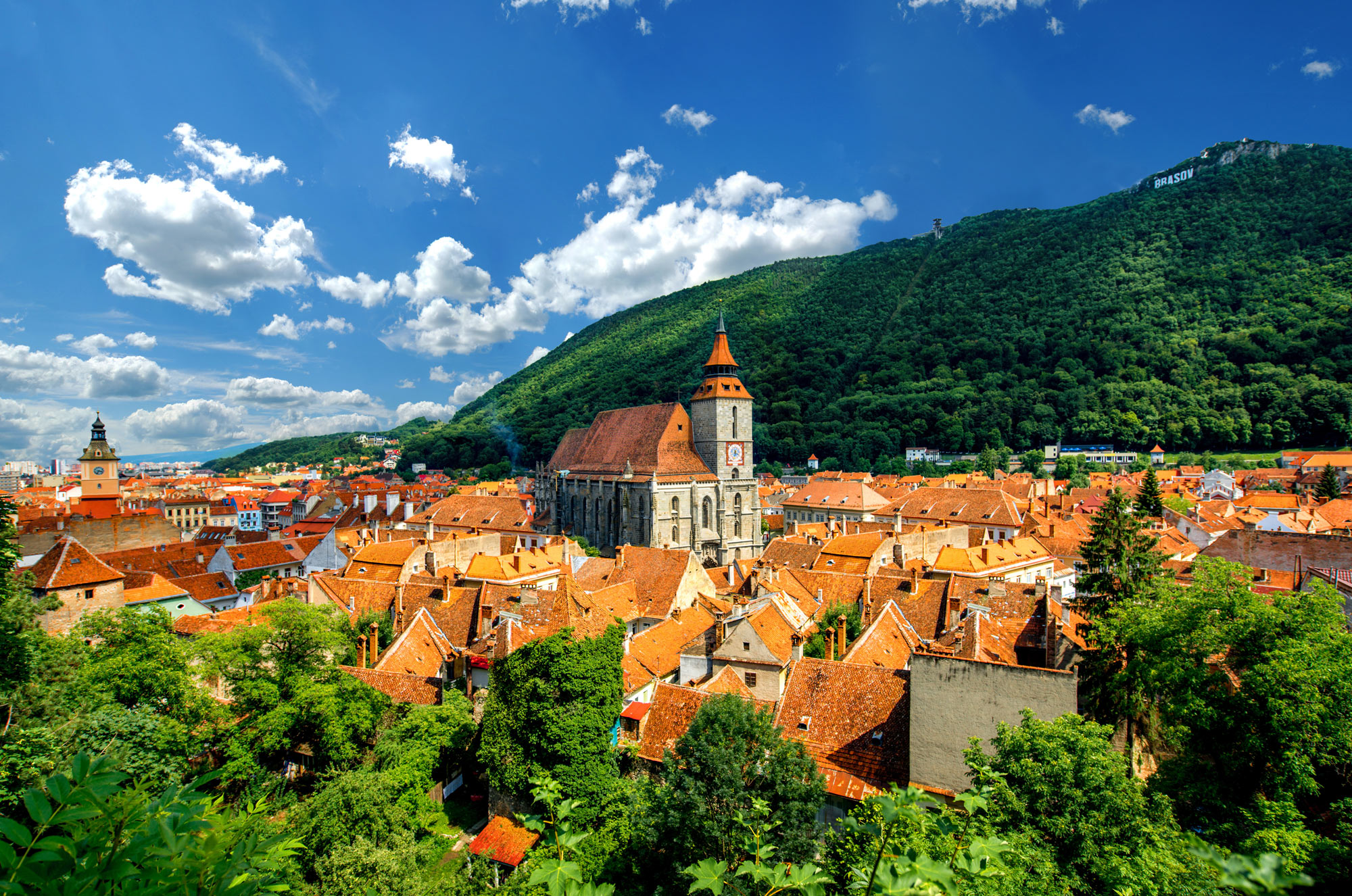
Fringed by the peaks of the Southern Carpathian Mountains and resplendent with gothic, baroque and renaissance architecture,
Brasov is one of the most beautiful and visited places in Romania.
Brasov was founded, in 1211, by the Teutonic Knights, on an ancient Dacian site.
In the 13th century Brasov was settled by the Saxons
and shortly became one of Transylvania's seven walled citadels Siebenburgen.
The location of Brasov, at the intersection of trade routes linking the Ottoman Empire and western Europe,
together with friendly tax regime, allowed Saxon merchants
to obtain considerable wealth and exert strong political influence in the region.
This was also reflected in the city's name, Kronstadt (German) or Corona (Latin), meaning the Crown City.
Strong fortifications defending towers were erected and maintained with funding provided the town's craft guilds.
Legend says that the Rope street was a meeting place for lovers whose parents did not approve their relationship and that couples who kissed on Rope street will never get apart.
The Old Townhall Square (Piața Sfatului)
is lined by colorfully painted and richely ornately baroque structures.
Just south of the Townhall Square, the Black Church (Biserica Neagra)
- the largest gothic structure in Romania -
got its name from the appearance of its exteriour walls, darkened by the flames and smoke of the 'Great Fire' of 1689.
The impressive interior of the church houses one of the largest organs in Eastern Europe
and an unique collection of antique rugs and kilims.
Above the sign there is a large terrace that offers an unique panorama of the city.
The sign - illuminated at night - can be seen from a distance of over 15 miles.
Near Brasov there are towering mountains, rolling fields, thick forests and century-old Saxon villages.
Brașov (Kronstadt ) is one of the Siebenbürgen (seven walled citadels) established by the Transylvanian Saxons.
The other walled towns in Transylvania are: Bistrita (Bistritz),
Cluj (Klausenburg),
Medias (Mediasch),
Sebes (Mühlbach),
Sibiu (Hermannstadt) and
Sighisoara (Schässburg)
...
Brasov Sights and Landmarks
The Council Square
(Piața Sfatului)
The Transylvanian Saxons built massive stone walls and seven bastions around the city (still visible today),
as well as ornate churches, elaborately decorated buildings and one of the most picturesque central squares in Transylvania,
said to be the spot to which the legendary Pied Piper led the children of Hamlin.
Located at the heart of old medieval Brasov and lined with beautiful red-roofed merchant houses,
the Council Square, known to the Saxon population as the Marktplatz, is a nice place to rest and watch the locals and visitors.

All tours listed below are "tip-based"; there is no set ‘price’ and no upfront payment is required.
At the end of the tour each participant gives the guide the amount that she/he considers appropriate.
| Tour Name click tour name for itinerary and reservations | Language* | Duration |
|---|---|---|
| Best of Brasov | En | 2h 30 min |
| Brasov Highlights, Tips and Fun Facts | En | 2h |
| In the footsteps of Transylvanian Saxons | De | 2h |
...
Brasov Old Town Hall
(Casa Sfatului)
Address: Piata Sfatului 30
Built in 1420, Casa Sfatului served for several centuries as meeting place for the town's council members.
At the beginning of the 17th century,
the building's watchtower became the place from which a trumpeter announced the top of the hour
and hence nicknamed "Trumpeter's Tower".
Today, the Old Town Hall houses Brasov History Museum
The Black Church
(Biserica Neagra)
Address: Curtea Johannes Honterus 2
Admission charge
Brasov Black Church hours and more info
Brasov's most distinctive landmark and Romania's largest Gothic church, the Black Church towers over the Council Square and Brasov Old Town.
Built between 1385 and 1477 on the site of an earlier church (destroyed during Mongol invasions in 1242),
the construction of the Marienkirche (Saint Mary), as it was known in German,
was hampered by extensive damage caused by Turkish raids in 1421.
The church was given its new name after disaster struck again in 1689, when the Great Fire leveled most of the town
and blackened the walls of the church. Restoration took almost 100 years. Of the two towers planned, only one was finished.
The seven-tons bell of the church is the largest - and heaviest - in Romania.
The original gothic interior got a makeover during restorations, and the lofty, light space you see today is mostly baroque.
The interior is beautiful, with balconies, stained glass windows, an enormous organ, stone columns and walls adorned with fabulous Turkish carpets.
The church windows have recently been fitted out with special UV-filtering glass to protect the 119 Anatolian carpets.
Thankful to have survived their trips into the "barbaric" lands south and east of the Carpathians,
German merchants donated the carpets to the church in the 17th and 18th centuries.
The collection is the largest of its kind in Europe.
Black Church's 4,000-pipe organ dates from 1839 and is still in function; concerts are offered several times a week.

Ever since Saxon settlers arrived in the early 12th century, invading Mongols, Turks and others gave them a tough time, repeatedly destroying the old settlements of Bartholoma and Corona. Thereafter, the Saxons set themselves to building fortifications around their town.
Most work was done between 1400 and 1650, when outer and inner walls were erected, together with massive defense towers and gates. Part of the defensive wall, once 40 feet high, seven feet thick and two miles long, can still be seen today, though most was taken down in the 19th century to make room for the city's expansion.
In the mid-18th century Brasov was home to 43 artisan guilds, reuniting 1.227 masters and journeymen.
Among the most important were: Saddlers Guild, Weavers, Spinners and Dyers Guild, Blacksmiths Guild and Furriers Guild.
Each major guild financed construction of - and covered the expenses to maintain - Brasov’s defending towers.
Of the original seven bastions, only a few have survived, including the Graft Bastion, located in the middle of the citadel's northwest wall.
On the west side of the wall, walk along picturesque Dupa Ziduri Street (Dupa Ziduri means Behind the Walls)
to catch a glimpse of the 15th century White and Black Towers.
The Blacksmiths' Bastion, one of the original seven built and guarded by the city's guilds,
is located at the southern end of Dupa Ziduri Street.
Follow the city wall southeast to the fairy-tale Catherine Gate (Poarta Ecaterinei).
Built in 1559 and once the main entrance to medieval Kronstadt, it is the only original city gate to have survived the test of time.
Nearby is the classicist Schei Gate, built in 1827. The Weavers' Bastion can be admired on George Cosbuc Street.
Did you know that the Saint Crispin shoes are hand-manufactured in Brasov,
a city known as Transylvania’s bastion of shoemaking since 1463?
What makes Saint Crispin footwear so special is that everything is handmade, from the shoe box to shoe last; even the shoe laces. Every year, twenty-two artisans hand welt, last, stitch, buckle and nap to perfection about 1,500 pairs of made-to-order shoes.
It takes six to eight weeks to create a pair of Saint Crispin shoes.
Graft Bastion
Bastionul Graft
This 16th century bastion (1521) has four levels, accessible through interior staircases.
Levels two, three and four host an array of medieval artifacts exhibits, while level one serves as a rest area for visitors.
White Tower
Turnul Alb
Located near Graft Bastion, the semicircular White Tower was completed in 1494.
A wooden staircase spirals up four levels, offering a great view of the old town.
Visitors will have to climb some 200 steps to reach the White Tower, constructed on the top of a hill.
Black Tower
Turnul Negru
The squared Black Tower, also built in 1494, stands atop a rock on Starja Hill near the Blacksmiths' Bastion.
The tower received its name from a severe fire in 1559 when it was struck by lightning.
Recently renovated and boasting a pyramid-shaped glass roof, the Black Tower houses a small war-related artifacts museum.
There are four floors inside, each reached by a narrow wooden ladder.
Climb all the way to the top for a panoramic view of the Black Church.
Blacksmiths' Bastion
Bastionul Fierarilor
First attested in 1529, the Blacksmiths' Bastion is now home to the Brasov Archives which hosts more than 100,000 old and rare documents,
including 80 valuable 14th - 16th century letters. Among them is the oldest letter in the Romanian language,
written in 1521 by Neacsu, a merchant from the town of Campulung.
Catherine's Gate
Poarta Ecaterinei
Catherine's Gate, erected in 1559 by the Tailors' Guild, is the only original gate to have survived from medieval times.
The fairy-tale tower we see today was part of a bigger structure, which unfortunately, was demolished in 1827.
The original structure can be seen at the Weavers' Bastion Museum where a large model of 16th century Brasov is displayed.
The four small corner turrets (as seen in other Saxon citadels) symbolized the judicial autonomy of the Town Council which could apply,
if necessary, the death penalty.
Above the entrance, the tower bears the city's coat of arms: a crown on a tree trunk.
Schei Gate
Poarta Schei
Entry to the Schei district from the walled city was marked by the Schei Gate.
Old documents mention it, also, under the name of Porta Valacce (Wallachs'Gate) because it was the only entrance for the Romanians living in Schei.
They were not allowed to use any of the other entrances.
The structure standing today was commissioned in 1827 by Emperor Franz I and replaced the old Schei Gate which had been heavily damaged by fires.
The gate resembles a triumphal arch with three openings. Above the small arches on both sides, you can see Latin inscriptions.
Brașov Fortress
Cetatea Brașovului / Cetatea Brassovia
Address: Dealul Cetății
Tel: (+4) 0268 417.614
Open: Mon. - Sun. 11 a.m. - 11 p.m.
Strategically located on a hill overlooking the town and the plains to the north, the citadel was part of Brasov's outer fortification system.
Built in wood in 1524, it was replaced with a stone structure in the 16th century,
only to be abandoned in the 17th century after technological innovations made cannons stronger than the building.
Weavers' Bastion
Bastionul Țesătorilor
Built during 1421 - 1436 and rebuilt in 1570 - 1573, this is the largest medieval bastion in Brasov
and the best-preserved among the seven original watchtowers constructed around the city walls.
Today, the Weavers' Bastion houses a small museum that can be visited on the way up Tâmpa Mountain.

Muntele Tâmpa
Brașov is often referred to as the city at the foot of Mountain Tâmpa.
Above the Weavers' Bastion, along the southeastern side of the fortress walls, there is an alley
(Aleea Tiberiu Brediceanu), shaded by old trees and dotted with benches.
From here, one can hike to the top of the mountain where the original defensive fortress was built.
When Vlad Tepes (the Impaler) attacked Brasov, in 1458, the citadel was destroyed;
40 merchants who refused to pay trade taxes were impaled, and displayed on top of the mountain.
Walking to the top takes about an hour; just follow the 'red triangle' marked trail
that begins at the cable car boarding point or the yellow triangle marked trail
which continues from Brediceanu Alley.
Those not in the mood for a little hiking can take the cable car
to the peak of the mountain (elevation 3,200 feet).
Mountain Tâmpa Cable Car - Brasov
Telecabina Tâmpa
Address: Aleea Tiberiu Brediceanu
Tel: (+4) 0268 407.342
Mt. Tâmpa Observation platform, located 1,400 ft. above the city,
offers spectacular views of Old Town Brasov.
The Panoramic Restaurant, Café and Terrace located on top of Tampa
offers good coffee and local and international dishes.

...
| Tâmpa Cable Car fast facts | |
|---|---|
| Start point elevation: | 2,100 ft. |
| End point elevation: | 3,151 ft. |
| Max. # of passengers: | 25 |
| Trip duration: | 2 minutes a little longer on bad weather |
| Days of operation: | Monday -- Sunday |
| Hours | Tuesday - Sunday: 10 a.m. - 11 p.m. Monday: noon -- 11 p.m. |
| Tâmpa Cable Car ticket cost | one-way | round-trip |
|---|---|---|
| Adult | 30 Lei | 45 Lei |
| Child, 6 to 12 y.o. | 20 Lei | 30 Lei |

Brasov was founded by Transylvanian Saxons and during the Saxon rule of Brasov, from the 13th to the 17th century,
Romanians settled in the southwestern part of the town, called "Schei" district.
Walk up Strada Prundului to Piata Unirii and the beautiful St. Nicholas Church;
then, wander around the small curving streets that gradually slope upwards against the hill.
Continue to the southern end of Schei and you'll end up on the gravel road to Solomon's Rocks (Pietrele lui Solomon),
a popular picnic area for locals during the weekend but relatively quiet all other times.
Saint Nicholas Orthodox Church
Biserica Sfantul Nicolae
Address: Piata Unirii 1 - 2
Saint Nicholas' Church dominates the Schei District.
First built in wood in 1392, replaced with a stone structure in 1495 and considerably expanded in the 18th century,
the church is a true architectural masterpiece.
With a mix of Byzantine, baroque and gothic styles, it features a slender tower and four corner towers.
Like other medieval churches, it is surrounded by protective walls with large wooden gates.
The enclosure shelters a small old cemetery where several *prominent people of Romania are buried. The First Romanian School,
now a museum, the Library and the Archives of Saint Nicholas Church also are found on nearby grounds.
Nicolae Titulescu (1882-1941), finance minister, foreign minister and president of the Assembly of the League of Nations
rests in the graveyard of the church.
The monument near his grave quotes a line from his will: "I wish to be buried in Transylvania.
My friends will know to find a place according to my wish."
Franciscan Monastery
Manastirea Franciscanilor
Address: Str. Sfintu Ioan 7
The monastery was built by the Lutherans in 1725 on the ruins of an old building destroyed by fire.
Later, it was given to the Franciscans monks. It houses a 1729 organ.
Saint Peter and Paul Roman-Catholic Cathedral
Catedrala Romano-Catolica Sfantul Petru si Pavel
Address: Str. Muresenilor 19-21
Built between 1776 and 1882 on the site of an old Dominican church, the cathedral is considered to be the most representative Baroque style building in Brasov.
Romanian Orthodox Cathedral
Catedrala Ortodoxa Adormirea Maicii Domnului
Address: Piata Sfatului 3
Located on the east side of the Council Square, opposite the Old Town House,
the Romanian Orthodox Cathedral was built in a glaring Byzantine style in 1896 and displays some impressive interior frescoes and decorations.
On Saturdays, brides and grooms line outside (being careful to avoid glancing at each other - bad luck) to get married here.
Saint Bartholomew Church
Biserica Sfantul Bartolomeu
Address: Str. Lunga 247
Considered the oldest architectural monument in Brasov, this church was built in 1223 in Roman architectural style mixed with early gothic elements. Inside, you can admire an ancient sundial on the southern side of the tower, as well as remarkably well preserved fragments of original frescoes.
Saint Martin Church
Biserica Sfantul Martin
Adddress: Str. Dealul de Jos 12
Not as richly decorated as other churches, Saint Martin Church has preserved its original 15th century form.
...
Jewish Brasov
Jews have lived in Brasov since 1807, when Rabbi Aaron Ben Jehuda was given permission to live in the city,
a privilege until then granted only to Saxons.
The Jewish Community of Brasov was officially founded 19 years later,
followed by the first Jewish school in 1864 and the building of the Synagogue in 1901.
The Jewish population of Brasov expanded rapidly to 1,280 people in 1910 and 4,000 in 1940.
Today, the community has about 230 members, after many families left for Israel between World War II and 1989.
The Beit Israel Synagogue - Brașov
Sinagoga Neologă Beit Israel
Address: Str. Poarta Schei 29
Open: Mon. - Fri.: 10 a.m. - 4 p.m.
Completed in 1899, the Beit Israel Synagogue reflects the rich heritage of the Neolog Jewish congregation in Romania.
Built in the Gothic Revival style with Moorish Revival elements
it features beautiful stained-glass windows that depict the coats of arms of 32 Israeli settlements.
The roof is crowned by a representation of the stone tablets of the Ten Commandments.
Up to 600 people can attend the mass and events inside the synagogue.
The structure also houses a kosher restaurant, communitycentre and, a medical office.
...
Walking tour of Brasov with a local guideTake a historical walk through Brasov's medieval section and discover the largest Gothic church east of Vienna,
the Town Council Square and the city's 14th century fortifications.
The tour ends with a general view of the Old Town from one of Brasov's medieval towers.
When:
April - May: every day at 6 p.m.
June - September: every day at 10:30 a.m. and 6 p.m.
October - March: every day at 3 p.m.
Tour starts: at Piata Sfatului (Town Council Square), next to the fountain.
(guide will have an orange umbrella)
Tour ends: at Turnul Alb (the White Tower).
Duration: 90 minutes to 120 minutes.
Brasov Walking Tour more info and reservations
Cost:
Tip-based tours do not have a set ‘price’ and no upfront payment is required.
At the end of the tour each participant gives the guide the amount that she/he considers appropriate.
In the centre of the square stands the Old Town Hall (1420),
now home to Brasov's History Museum, while the southeast corner is dominated by the town's most famous landmark, the Black Church.
The square is surrounded by the renaissance-style Merchant's House (now Cerbul Carpatin restaurant),
the beautiful archway of the Orthodox Cathedral and the memorial museum of the Mureseanu family.
Short Hikes
Brasov is located at the foot of Mountain Tâmpa and,
there are several hiking trails that practically begin at the edge of the Old Town.
Here are a few options for short hikes from Brasov to the top of Tâmpa (3,133 ft.), the highest observation point in Brasov:

Trail name: Drumul Serpentinelor (The Crocky Trail)
Trail marking: red triangle
Length: half mile
Aleea Brediceanu - Cablecar – Panoramic Restaurant – Peak Tâmpa
Trail name: Drumul Cavalerilor (Knights’ Trail)
Trail marking: Blue Stripe
Length: 1.5 miles
Bastionul Tesatorilor – Peak Tampa - the trail continues to Poiana Brasov ski town (three hours each way)
Trail name: Dealul Melcilor (Snails’ Hill)
Trail marking: Blue Triangle
Length: 1.5 miles
Dealul Melcilor – Saua Tampei – Peak Tampa
Trail name: Treptele lui Gabony (Gabony’s Steps)
Trail marking: Yellow Triangle
Length: 1.8 miles (one hour)
Bastionul Funarilor – Promenada Tampei – Drumul Scarilor - Peak Tampa
This is the most demanding trail, with two steep ascents including a 167-step climb.
However, it offers more spectacular panoramic views of the city of Brasov than any other trail.
...
24 hours in Brasov - a video introduction"... Its colorful rooftops spill like a sea of terracotta,
interrupted by the soaring spire of a Gothic cathedral and the timeless charm of its old town square."
(Zachary Allen Murphy, photographer, video content creator, explorer.)
...
Brasov Museums
Brasov Art MuseumMuzeul de Arta - Brasov
Address: Bulevardul Eroilor 21
Telephone: (+4) 0268 477.286
The first and second floors oare home to the National Gallery, a collection of canvases,
by anonymous, 18th and 19th century, Transylvanian painters as well as 20th century artists,
including Theodor Pallady, Nicolae Grigorescu, Stefan Luchian, Horia Bernea,
Nicolae Tonitza, Gheorghe Petrascu, Dimitrie Paciurea, Ion Irimescu, Misu Popp, Constantin Lecca, Hans Eder
Brasov Art Museum also displays works by Brasov-born Hans Mattis-Teutsch (1884-1960), one of the most influential Romanian artists,
as well as sculptures by Corneliu Medrea, Ion Jalea, Frederic Storck and Dimitrie Paciurea.
The basement level features beautiful European crystal and porcelains and a large collection of Oriental vases and statuettes from China, Tibet and Persia.
Brasov History Museum - Old TownhallMuzeul de Istorie al Brasovului
Address: Piaţa Sfatului 30
Housed in the Old Town Hall building, Brasov History Museum displays documents and objects attestings Brasov's long history
from ancient to modern times: tools made in stone (Paleolithic age), (Neolithic age)
painted ceramics, tools made in bronze and iron, armor, ancient weapons and farming tools.
The exhibits also tell the history of the Saxon guilds, which dominated Brasov during medieval times.
Hours: Tuesday – Sunday: 10 a.m. – 6 p.m.
Admission:
Adults: 7 lei ($1.75)
Senior citizens: 4 lei ($1.00)
Students: 1.50 lei ($0.40)
Muzeul de Etnografie Brasov
Address: Blvd. Eroilor 21 A
Tel: (+4) 0268 476.243
Hours: Tuesday - Sunday: 10 a.m. - 6 p.m.
Admission charge
Brasov Ethnography Museum exhibits silver jewelry crafted in Brasov during the 16th century,
fur and sheepskin coats and other folk costumes; black and white photographs illustrate exactly how they were worn and by whom.
The museum also presents the evolution of weaving from an old spinning wheel to a mechanized loom.
Folk art and local crafts are available at the museum gift shop.
Muzeul Prima Scoala Romaneasca
Address: Piata Unirii 2 - 3
(on the grounds of St. Nicholas Church)
Tel: (+4) 0268 511.411
Hours: Tuesday - Sunday: 10 a.m. – 5 p.m.
Brasov was for centuries one of the leading learning centres of the Romanian people.
The printing press that opened here in 1556 produced some of the first books written in Romanian.
The museum hosts a compelling legacy: more than 4,000 rare books (many printed or copied by hand on the premises),
several hundreds rare documents, the oldest Bible (printed on goat's skin) and much more.
Muzeul Memorial Casa Muresenilor
Address: Piata Sfatului 25
Tel.: (+4) 0268 477.864
Hours:
Tuesday – Friday: 9 a.m. – 5 p.m.
Saturday – Sunday: 10 a.m. – 5 p.m.
Free admission
Established in 1968, due to generous Mureseanu family donations, Casa Muresenilor features the largest family archive in Romania: a collection of over 25,000 documents, letters, photographs, newspapers, rare books, paintings, sculptures, 19th century furniture.
Muzeul Fortificatiilor din Tara Barsei / Bastionul Tesatorilor
Address: Str. George Cosbuc 9
Tel: (+4) 0268 472.368
Open: Tue. - Sun. 10 a.m. - 5:30 p.m.
Admission Charge
This small museum, housed inside the bastion, exhibits Middle Age documents, photographs of long-lost bastions, armor,
impressive Turkish weapons decorated with Arabic inscriptions, tools used by local artisans, guild flags, a street lamp from the 16th century,
pieces from an aqueduct, rare books and much more.
Most impressive is the elaborate small-scale model of Brasov circa 1600, made in 1896 for the Millennium Exhibition in Budapest.
Museum Pass Brașov
offers a convenient option to visit city's museums and other attractions:
~ Brașov History Museum / Old Townhall
~ The Black Church
~ Weavers' Bastion
~ Romanian School Museum
~ Brașov Ethnographic Museum
~ Urban Civilization Museum - Brașov
~ Brașov Art Museum
~ "Casa Mureşenilor" Museum
~ "Casa Ştefan Baciu" Museum
~ Săcele Ethnographic Museum - Sacele (8 miles SE)
~ "Gheorghe Cernea" Ethnographic Museum - Rupea (40 miles NW of Brașov)
Museum Pass Brașov cost and validity:
Adult: 58 lei (approx. $12.50)
Senior citizen: 42 lei (approx. $9.25)
Children (4 - 12 y.o.): 21 lei (approx. $4.50)
Pass allows one visit to each museum and is valid for 90 days, from the date of purchase.
...
Brasov Performing Arts Venues
Opera & Ballet
Brasov Opera
Opera Brasov
Address: Str. Bisericii Romane 51
Tel: (+4) 0268 415.990
Symphonic Music
Brasov Philharmonic
Filarmonica Brasov
Address: Str. Apollonia Hircher 10
Tel: (+4) 0268 473.058
Drama Theatre
Sica Alexandrescu Drama Theatre
Teatrul Sica Alexandrescu
Address: Piata Teatrului 1
Tel: (+4) 0268 418.850
Arlechino Puppet Theatre
Teatrul de Papusi Arlechino
Address: Str. Apollonia Hirscher 10
Tel: (+4) 0268 475.243
...
Attractions Near Brasov
Poiana BrasovWhere: 5 miles SW of Brasov
Access: Bus #20 leaves every half-hour from Livada Postei bus station
A 15-minute drive or 30-minute bus ride from Brasov leads to Poiana Brasov (3,300 feet), a mountaintop ski and summer resort. During winter months, Poiana Brasov offers some of the best skiing in Romania. In the summer, it is a great place for hikers to launch treks into the Southern Carpathian Mountains. For a panoramic view of Brasov and the more distant Bucegi Mountains, take the cable car to the summit of Postavarul Mountain (5,756 feet).
Rasnov Fortress
Cetatea Rasnov
Where: 9 miles southwest of Brasov
Access: car, bus
Rasnov Fortress info
Rasnov Dino Park
Where: 10 miles southwest of Brasov
Access: car, bus
Included by FatherMag.com in the list of "top 50 destinations in Europe that every kid and family should experience at least once in their lifetime" Dino Parc - Râșnov is home to over 100 models of real-size dinosaurs that can be seen while hiking and trekking through the park.
Rasnov Dino Patrk also features playgrounds, treehouses, adventure trails, laser labyrinths, state-of-the-art cinemas as well as virtual reality interactive areas and an erupting interactive volcano.
Dino Parc - Râșnov more info
Bran (Dracula's) Castle
Where: village Bran, 16 miles southwest of Brasov
Access: car,
bus;
buses Brasov to Bran leave from Brasov bus terminal # 2 (Autogara Bartolomeu),
travel time 45 minutes.
Bran (Dracula) Castle info
Harman Fortified Church
Where: 4 miles north of Brasov
Access: car, bus
Harman Fortress info
The Fortified Church at Prejmer
Where: 6 miles northeast of Brasov
Access: car, bus, train
Prejmer is a short train journey from Brasov on the line towards town of Sfantu Gheorghe.
Note: Get off at Ilieni halt, which is actually closer to the church
than Prejmer station itself)
Prejmer Fortress info
Zarnesti Bear Sanctuary
Where: 23 miles west of Brasov
Access: car, bus, train
Zarnesti Bear Sanctuary info
Racoș Nature Reserve
Rezervația naturală Complexul Geologic Racoș
Where: village Racoș , 44 miles north of Brasov
Main attractions include Racos extinct volcano, the Emerald Lake and the Basalt Organ/ Colums
Visitors traveling from Brasov to Sighisoara can easily reach Racos Nature Reserve, 15 miles detour.
Access: car, bus
Rupea Saxon Fortress
Cetatea Rupea
Where: town of Rupea , 42 miles north-west of Brasov
Access: car, bus, train
Rupea Fortress info
...
Day Trips from Brasov
Sighisoara Medieval Citadel
Where: 72 miles northeast of Brasov
Access: car, bus, train
Optional stops/ visits: Racos Nature Reserve (15 miles detour), Rupea Saxon Fortress, Crit Fortified Church, village Saschiz
Sighisoara info
Where: 45 miles west of Brasov
Access: car, bus, train (approx. 1 ½ hours away)
Optional stops/ visits: Town of Codlea
Fagaras Fortress info
Where: 85 miles west of Brasov
Access: car, bus, train (approx. 2 ½ hours away)
Optional stops/ visits: town of Codlea, Fagaras Fortress, Monastery Sambata/ Brancoveanu (14 miles detour),
Fortress Cisnadioara (8 miles detour), village Rasinari (16 miles detour)
Town of Sibiu info
Where: 40 miles south of Brasov
Access: car, bus, train
Optional stops/ visits:
town of Azuga - Rhein Cellars, sparkling and still wines tasting
town of Busteni - Cantacuzino Palace,
cable-car
to Babele (the Old Dames) and Sfinxul (Sphinx) rock formations, 7,520 feet altitude.
Peles castle - Sinaia info
Where: 49 miles northeast of Brasov
Access: car
600 acres protected woodland and mossy areas and 200 acres marshes/ peat bog.
Mohoş peat bog is home to unique flora and fauna (including ice-age relict plants and rare arthropods)
and the largest habitat of Drosera (carnivorous plant), in Romania.
Optional stops/ visits:
town of Sfantu Gheorghe, Lake St. Anne (formed in a volcanic crater), Tusnad spa town (20 miles detour).
Return to Brasov, via Targu Secuiesc, detour itinerary (63 miles):
Lake St. Anne -- Balvanyos spa town -- town of Targu Secuiesc -- Reci Nature Reserve
Total distance (detour route): 112 miles
Tinovul Mohoş more info
...
a private day trip can be a convenient way to discover the region's historic towns, castles, and mountain scenery. Travel with a local English-speaking driver and fully enjoy the journey, and you'll also have the option to make sightseeing stops along the way.
...
Brasov Festivals & Events
Major festivals in Brasov include:
~ Brasov's Lads Parade Junii Brasovului
(first Sunday following the Orthodox Easter)
~ International Chamber Music Festival (September)
~ Brasov OktoberFest - Beer Festival (September)
~ International Opera Festival (September)
~ Brasov International Jazz Festival (November)
~ Contemporary Drama Festival (November)
A calendar of Romania festivals and celebrations is available at RomaniaTourism events section.
...
Brasov Trip Planning Information
Transportation
Air Transportation to BrasovBrasov International Airport
Aeroportul International Brasov
Brasov airport is located in town of Ghimbav, 6 miles northwest of Brasov city-centre
Address: Strada Aeroportului Brasov, Ghimbav
Telephone: (+4) 0268 410.777 x 212
Buss A1 (express) connects Brasov Train Station with Brasov Airport.
Stops: Civic Center, Livada Postei, Bartolomeu.
One ticket costs 4 lei (approx. $ 0.85).
Airlines with service to Brasov include: Dan Air and Wizz Air.
International airports not very far from Brasov:
Bucharest (OTP) - 100 miles south of Brasov
Targu Mures (TGM) - 105 miles north of Brasov
Sibiu (SBZ) - 85 miles west of Brasov
...
Travel by car to / from BrasovThe fastest route from Bucharest to Brasov is E60:
Bucharest - Ploiesti - Comarnic - Sinaia - Predeal - Brasov
(Note: on weekends, traffic between Comarnic and Predeal can be quite busy,
expect delays).
| Distance from Brasov to: | |
|---|---|
| City | Distance |
| Bucharest | 100 miles |
| Arad | 250 miles |
| Belgrade (Serbia) | 330 miles |
| Budapest (Hungary) | 420 miles |
| Cluj-Napoca | 160 miles |
| Constanta | 215 miles |
| Iasi | 180 miles |
| Oradea | 250 miles |
| Prague | 760 miles |
| Satu Mare | 250 miles |
| Sibiu | 85 miles |
| Sighetu Marmatiei | 235 miles |
| Sighisoara | 72 miles |
| Suceava | 190 miles |
| Targu Mures | 105 miles |
| Timisoara | 240 miles |
| Tulcea | 195 miles |
| Vienna (Austria) | 590 miles |
...
Travel by train to / from BrasovBrasov Train Station
Gara Brasov
Bd. Garii 5
Tel: (+4) 0268 410.233
The train station is located 2 miles from downtown.
Bus # 4 runs from the train station to Piata Unirii in the city centre.
There are 3 direct international trains from/to Budapest (Hungary).
One of them continues to Vienna (Austria) and another to Bratislava Slovakia) and Prague (Czech Republic).
For the list of international trains with service to/from Romania please visit
RomaniaTourism International Transportation section
There are daily trains from/to Bucharest connecting Brasov to Arad, Cluj-Napoca, Oradea, Satu Mare, Sibiu, Sighisoara and several other cities in Romania. There is also an overnight train to Suceava.
There is daily INTERCITY (Express) service between Bucharest and Brasov (approximate journey time: 2 ½ hours).
To check train and bus schedules for domestic routes please visit
RomaniaTourism Domestic Transportation section
Note: For departures from /to Bucharest please select Bucuresti Nord.
SNCFR's advance booking office
Agentia de Voiaj SNCFR Brasov
Address: Str. 15 Noiembrie 43
Tel: (+4) 0268 477.018
The SNCFR ticket office offers train schedules information and advance ticket sales.
Tickets for same-day travel can only be purchased at the train station.
...
Bus travel to / from BrasovInter-City Brasov Bus Stations - international & domestic bus service
Brasov Bus Station # 1
Autogara 1 Brasov
Address: Bd. Garii 5
(next to the train station)
Tel: (+4) 0268 427.267
Brasov Bus Station # 2
Autogara 2 Brasov / Autogara Bartolomeu
Address: Str. Avram Iancu 114
Tel: (+4) 0268 426.332
Brasov Bus Station # 3
Autogara 3 Brasov
Address: Str. Harmanului 47A
Tel: (+4) 0268 332.002
Bus Companies Serving Brasov, international service:
Anesis
Address: Str. Poterasi 20-22
Tel: (+4) 021 330.91.76
Scheduled service to Athens (Greece)
Atlassib
Address: Blvd. Gh. Duca 4
Tel: (+4) 021 222.47.35
Scheduled service to France, Germany, Italy, Sweden
DoubleT
Address: Calea Victoriei 2
Tel: 021 313.36.42
Scheduled service to Austria, Germany, Greece, Italy, Switzerland
Eurolines Touring
Address: Blvd. Al. Ioan Cuza 5A
Tel: 021 210.08.90
Scheduled service to Germany with connections to any country in Europe
Murat
Address: Blvd. Dinicu Golescu 31
Tel: (+4) 021 336.62.15
Daily service to Istanbul (Turkey)
Toros
Address: Calea Grivitei 136-138
Tel: (+4) 021 223.18.98
Daily service to Istanbul (Turkey)
...
Brasov Bicycle RentalActive Travel
Address: Str. Republicii 50, Brasov
Telephone: (+4) 0727 872.835
E-mail
SportLink
Address: Strada De Mijloc 31, Brasov
Telephone: (+4) 0721 244.552
E-mail
...
Brasov Local Public TransportationBrasov Local Transport Authority
(Regia Autonoma de Transport Brasov - RATBV)
operates 47 bus, 'midi-bus' and trolleybus routes within the city limits.
Brasov local public transport
Schedules and Routes
Urban Routes Map
Transportation between Brasov train station and city centre:
Bus # 4
[ Brasov Train Station (Gara) - Old Town - Livada Postei (city centre) ]
Bus #4 connects the train station with the bus stop for buses departing to Poiana Brasov.
Transportation between Brasov and Poiana Brasov ski town:
Bus # 20
[ Livada Postei (city centre) -- Poiana Brasov ]
or bus # 100
Brasov Train Station -- Poiana Brasov.
Transportation between Brasov train station and Bran / Dracula Castle bus station:
Bus #19
[ Brasov Train Station - Ecaterina Teodoroiu/ walk 400 yards to Autogara 2 - Bartolomeu ]
Brasov public transportation fares:
Bus / trolley-bus ticket: 4 Lei ($0.85) for one trip (60 minutes).
Day-Pass: 12 Lei ($2.60)
Three-days Pass: 30 Lei (approx. $6.50)
(valid on all bus/ trolley-bus lines except Express Bus # 20)
One ticket for Express Bus # 20 (Brasov to Poiana Brasov) costs 6 Lei / trip (approx $1.40).
Tickets can be bought from the RATBV kiosks, vending machines or driver;
only two-trips tickets can be purchased form driver (costs is 10 lei / equivalent of $2.25).
...
| Brasov Taxi Companies | |
|---|---|
| Name | Phone # |
| Tod Taxi | (+4) 0268 321.111 |
| Taxi Brasov | (+4) 0745 451.283 |
| Martax | (+4) 0268 313.040 |
| Bratax | (+4) 0268.948 |
| Taxi 4T4U | (+4) 0722 405.646 |
| Cris Taxi | (+4) 0721 692.157 |
...
Brasov Car RentalGreat car rental rates in Brasov.
Autonom
Tel: (+4) 0268 415.250
Budget
Tel: (+4) 0268 474.564 or (+4) 0722 500.220
Ecoline
Tel: (+4) 0268 546.137
EuroCars Romania
Tel: (+4) 0727 373.799
Promotor Services Rent a Car Brasov
Tel: (+4) 0740 031.173
Sixt
A
Tel: (+4) 021 94 00 (this is valid short phone #)
...
Brasov Shopping
Brasov Art Galleries
Kron-Art Gallery
Address: Blvd. Republicii 38
Tel: 0268 475.971
Saba Art Gallery
Address: Blvd. Baritiu 4
Tel: 0268 473.438
Antique Shops
Dana's Art & Antiques
Address: Str. 15 Noiembrie nr.8
Tel: 0268 474.062
Traditional Handicrafts
Authentic handicrafts such as embroidered clothing and linen, lacework, painted or beaded eggs, carpets, pottery, tablecloths, woodcarvings and icons are being offered by specialized shops, usually called Artizanat.
Aladin
Address: Str. Michael Weiss 2
Tel: (+4) 0268 144.455
Artizanat
Address: Blvd. Republicii 48
Tel: (+4) 0268 144.546
Artizanat
Address: Bd. Republicii 35
Brasov local beers include: Mustata de Bere (artisanal), Ciucas, Bucur (artisanal).
| Brasov Shopping Malls | Address | Telephone |
|---|---|---|
| Coresi Shopping Center | Str. Zaharia Stancu 1 | (+4) 0736 738.787 |
| Unirea Shopping Center Brașov | Bulevardul Gării 3A | (+4) 0268 301.030 |
| AFI | Bulevardul 15 Noiembrie 78 | (+4) 0731 348 300 |
...
Brasov Hotels
Accommodations in Brasov include:
| Hotel Name | Class | Location |
|---|---|---|
| Schuster | boutique | Old Town Brasov |
| Casa Chitic | boutique | Old Town Brasov |
| Curtea Brasoveana | boutique | Old Town Brasov |
| Upper House | boutique | 0.6 miles south of Old Town Brasov |
| Kronwell | four-star / upscale | Brasov Train Station - 2 miles northeast of Old Town Brasov |
| ARO Palace | four-star / upscale | Old Town Brasov |
| Belvedere | four-star / upscale | 0.8 miles N of Old Town Brasov |
| Bella Muzica | three-star / midscale | Old Town Brasov |
| Belfort | three-star / midscale | Old Town Brasov |
| Ambient | three-star / midscale | Brasov City Centre |
| Radisson | four-star / upscale | Old Town Brasov |
...
Brasov restaurants worth trying:
| Restaurant Name | Cuisine | Location |
|---|---|---|
| Bloom | Local and International | Brasov Old Town |
| Bisto de l’Arte | Local / International | Brasov Old Town |
| Bella Muzica | Local / International | Brasov Old Town |
| Sergiana – Stana Turistica | Local / Traditional Romanian | Poiana Brasov, 7 miles SW of Brasov Old Town |
| Ograda | Local | Brasov Old Town |
| La Ceaun | Local and International | Brasov Old Town |
| Casa Romaneasca | Local / Romanian | Brasov Old Town – Schei neighborhood |
Brasov Local Beers:
Artisan beers produced in Brasov include:
Bere Mustata,
Czell,
Danila’s - Bere Schei
and
Ciucas.
...
Brasov Tourist Info
City of Brasov Tourist Info Centre
Centrul de Informare Turistica Brasov
Address: Aleea Primaverii 23 A
Telephone: (+4) 0774 035.072 or (+4) 0268 405.000 ext. 243
E-mail
Hours:
Mon. & Fri.: 10 a.m. - 3 p.m.
Tue., Wed. and Thu.: 9 a.m. - 5 p.m.
Sat. & Sun.: 11 a.m. - 2 p.m.
Brasov Tourist Info Centre offers free WiFi, maps, brochures and travel advice.
Brasov County Tourism Department
Asociatia pentru Promovarea si Dezvoltarea Turismului
Address: Bd. Eroilor 5
Telephone: (+4) 0756 093.502
E-mail.
...
Brasov Health Care and Emergency
General Emergency phone number: 112
(Ambulance, Firefighters, Police)
Pharmacies (Farmacie) open 24 hours a day in Brasov include:
| Name | Address | Telephone # |
|---|---|---|
| Farmacia Dona - Nicopole | Strada Nicopole 65, parter | (+4) 0372 407.175 |
| Farmacia Ecofarmacia - Iuliu Maniu | Strada Iuliu Maniu 68 | (+4) 0268 413.044 |
| Farmacia Farmacom - Griviței | Bulevardul Griviței 67, Tractorul | (+4) 0268 332.143 |
| Farmacia Farmacom - Uranus | Strada Uranus 12 - 14, Zizin | (+4) 0268 332.143 |
...
Brasov Hospitals
| Name | Address | Telephone # |
|---|---|---|
| Brasov Emergency Clinic Hospital Spitalul Clinic Judetean de Urgenta Brasov |
Calea Bucuresti 25-27 | (+4) 0268 320.002 |
| Brasov Children's Hospital Spitalul Clinic de Copii |
Address: Strada Nicopole 45 | (+4) 0268 415.130 |
| Brasov Military Hospital Spitalul Militar de Urgenta |
Address: Strada Pieții 9 | (+4) 0368 464.210 |
| Railways Company Hospital Spitalul C F R |
Bd. 15 Noiembrie 60 | (+4) 0268 475.949 |
| Infectious Diseases Hospital Spitalul de Boli Infecțioase |
Strada Mihai Viteazul 9 | (+4) 0268 422.464 |
...
Brasov Local AuthoritiesBrasov City Hall
Primaria Brasov
Address: Bd. Eroilor 8
Telephone: (+4) 0268 416.550
Brasov County Archives
Directia Judeteana Brasov a Arhivelor Nationale
Address: Str. Gh. Baritiu 34
Brasov, postal code 500025
Tel: (+4) 0268 475.256
E-mail
Hours
Brasov Consumer Protection Agency
Comisariatul Judeţean pentru Protecţia Consumatorilor Braşov (ANPC)
Address: Str. A. I. Cuza 12
Tel: (+4) 0268 413.951
E-mail
...
Postal ServicesBrasov Main Post Office
Address: Str. Nicolae Iorga 1
Tel: (+4) 0268 471.260
Hours:
Mon. - Fri.: 8 a.m. -- 7 p.m.
Sat.: 9 a.m. -- 1 p.m.
Post offices display the word POSTA.
Telephoning Brasov from Abroad
International Access Code +4 (country code) + 0268 or 0368 (area code) + six-digit telephone number
...
Brasov Maps
Brasov Old Town Map (Harta Orasului Vechi Brasov)
City of Brasov interactive Street Map (Harta Interactiva Brasov)
Romania Main Roads and Tourist Attractions Map ( Romania - Harta Atractii Turistice)