
Oradea Fast Facts
Name: Oradea (pronounced: O ra dê ah)
Location: Crisana Region (NW Romania)
Nearest airports: Oradea , Arad and Cluj
Area: 13.5 sq. miles (35 sq. kilometers)
Elevation: 492 ft. (150 meters)
Population: 184,000
First documented: 1113 AD
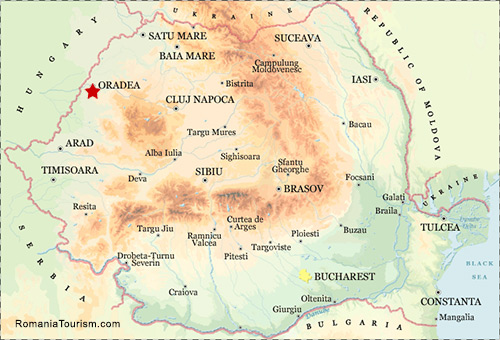
Located just 8 miles east of Romania's border with Hungary and spanning both shores of the Crisu Repede River, the elegant city of Oradea is a great starting point for exploring Romania, for visitors arriving, by car or train, from Central Europe.
First documented in 1113, under the Latin name Varadinum, the city was administered at various times by the Principality of Transylvania, the Ottoman Empire, and the Habsburg Monarchy. In 1598, the Oradea fortress was besieged and, on August 27, 1660, it fell to the Ottoman raids, only to be seized in 1692 by the Austrians.
Until the construction of flood-banks along the length of the Crisu Repede River, Oradea was facing constant flooding threats. In 1836 a large part of the town was destroyed by fire. The picturesque town of present-day Oradea was rebuilt in the 18th century to the plans of Viennese engineer Franz Anton Hillebrandt following the then-trendy Austrian architectural style called Secession with its richly decorated facades of pale pink, blue, green and white. In addition to the many Baroque buildings, Oradea is remarkable for its particularly rich collection of Art Nouveau architecture.
Oradea University, one of the largest in Eastern Europe, is an excellent educational center in literature, as well as in medicine and sciences.
All tours listed below are "tip-based"; there is no set ‘price’ and no upfront payment is required.
At the end of the tour each participant gives the guide the amount that she/he considers appropriate.
| Tour Name click tour name for itinerary and reservations | Language* | Duration |
|---|---|---|
| Oradea: from Medieval to La Belle Époque | En | 2h 30min |
| Baroque, Art Nouveau and mores | En | 2h 30min |
| Oradea Jewish Heritage | En | 2h |
...
Oradea Sights and Landmarks
Oradea's most notable landmark include:
the Union Square (Piata Unirii),
King Fedinand Square (Piata Regele Ferdinand),
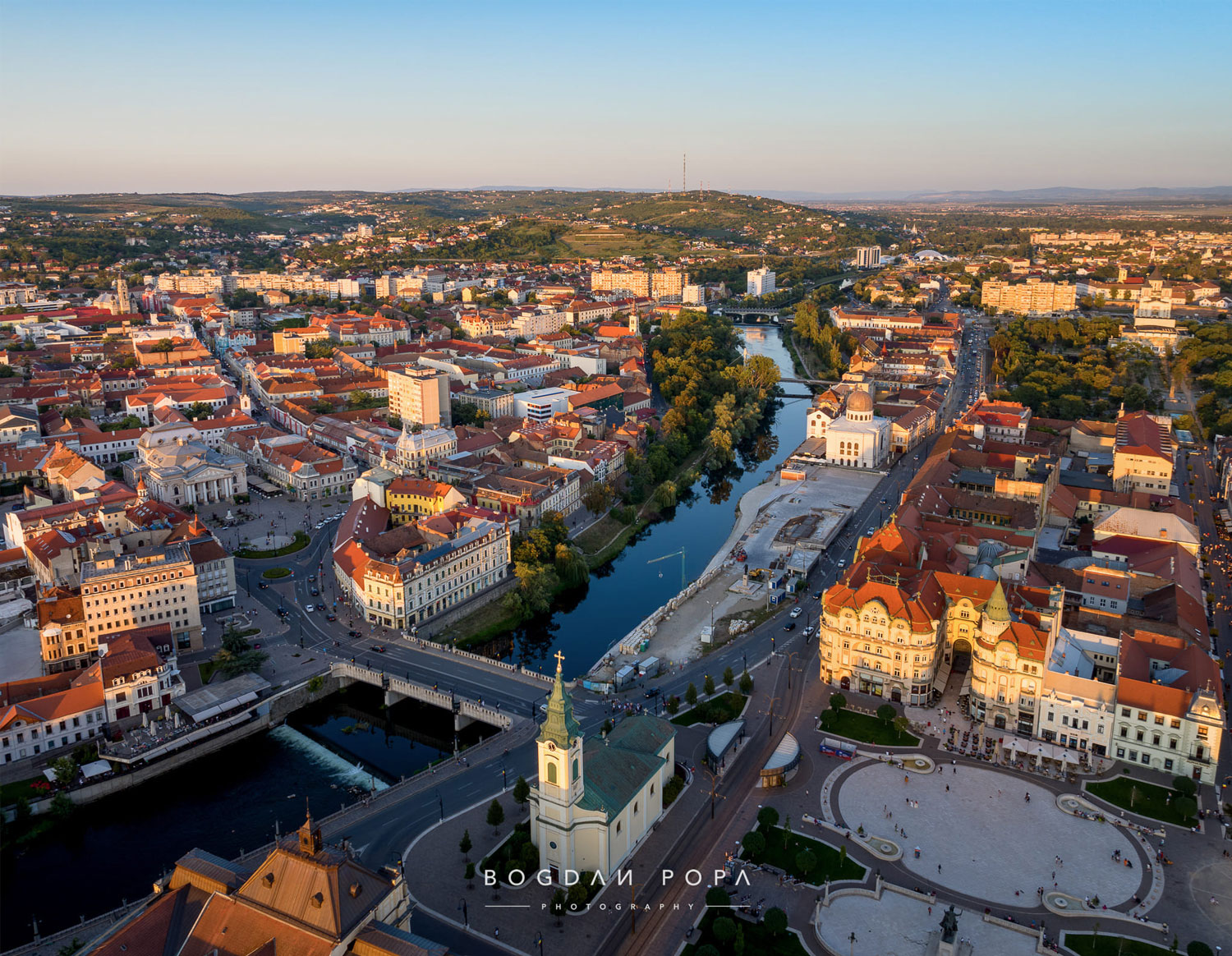
Bishop's Palace (Palatul Episcopal), one of Oradea's most splendid edifices,
modeled on drawings by Italian architect Giovanni Battista Ricca
and completed in 1770 by Austrian architect Franz Anton Hillerbrandt.
Today this three-story, U-shaped, structure featuring 100 fresco-adorned rooms, 365 windows,
and a facade punctuated with ionic capitals is home of Crisana Region Museum (Muzeul Tarii Crisurilor).
The Roman Catholic Episcopal Palace - Oradea (Palatul Baroc), completed in 1780,
is Romania's largest Baroque religious edifice.
It is part of the architectural ensemble designed by Austrian architect Franz Anton Hillebrandt
and also includes the Bishop's Palace and ten other structures known as Canon's Row.
The Black Eagle Palace (Palatul Vulturul Negru) located in Piata Unirii,
was built between 1907 and 1909 after plans by architects Marcell Komor and Dezso Jakab.
A glass-roofed art nouveau shopping arcade (Pasajul Vulturul Negru)
that runs through the two main buildings of the palace houses
shops, a four-star hotel, cafes and a cinema.
The late Baroque Church of the Moon (Biserica cu Luna), was completed in 1790.
The clock mechanism, installed in 1793,
features a half-gold, half-black sphere, maintained in perpetual motion, reproducing the phases of the moon and lending the church its name.
Strada Republicii, a pedestrian-only shopping area, displays numerous Secession architecture buildings.
In the summertime, the café terraces lining the banks of the Crisu Repede afford some great views of the town's lavish landmarks.
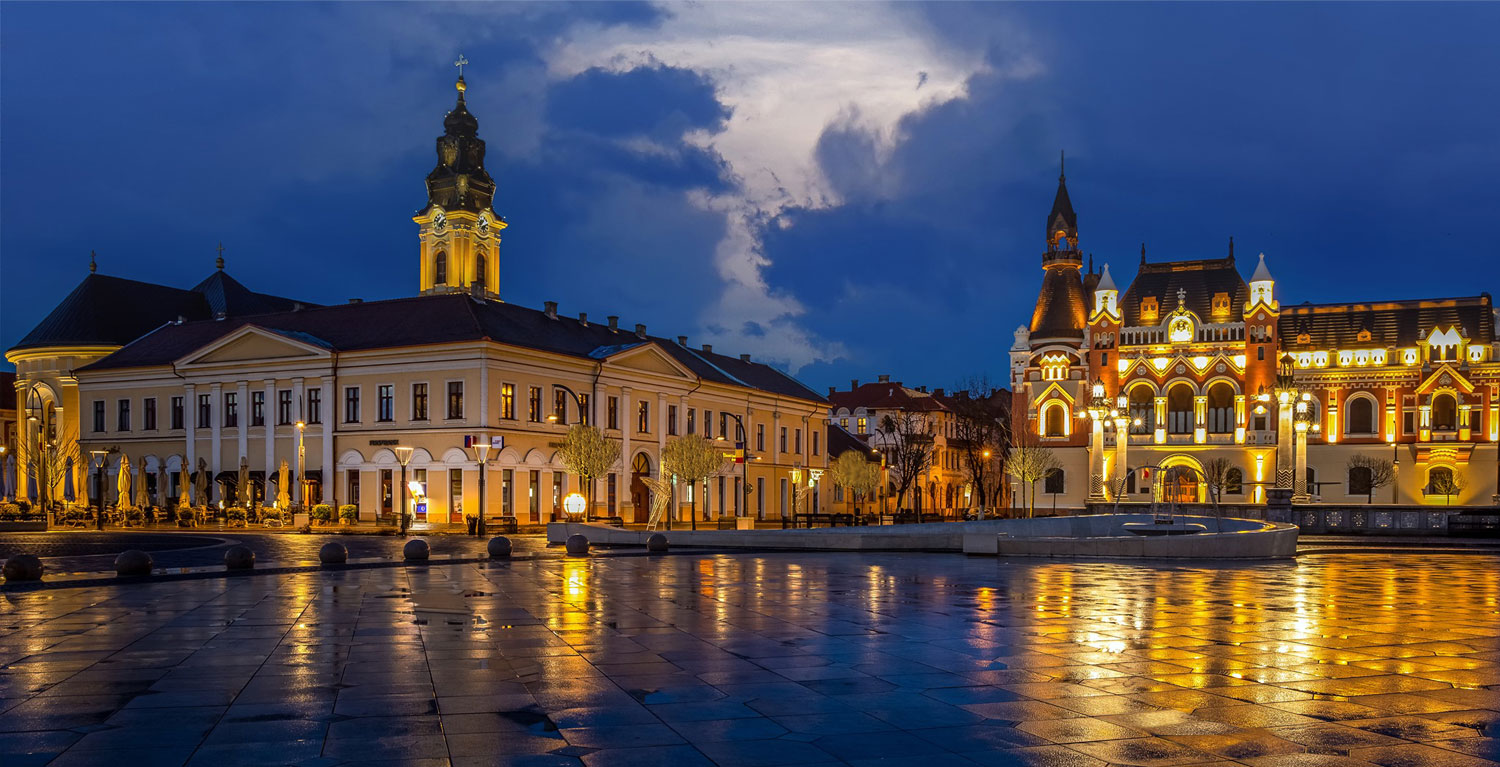
The The Greek Catholic Bishopric Palace, located opposite the Church of the Moon, was designed by local architect Kalman Rimanoczy Jr. Built in 1903, the edifice features a sophisticated eclectic combination of decorative elements: Neo-Romanesque, Neo- Gothic, Neoclassical and Neo-Byzantine.
The robust, asymmetrical, Oradea City Hall (Primaria) was designed, in 1903, by architect Kalman Rimanoczy Jr. as well. The building features a 170 feet-tall tower with four clocks – one on each of its sides - and three observation decks. Local watchmaker Mezey Dezső built the main mechanism of the clocks, called the "mother clock", in 1904. At the top of the hour the clock plays a fragment from Iancu’s March (Marsul lui Iancu), a 1849 revolutionary song. Oradea City Hall Tower is open to visitors Tuesday through Sunday from 10 a.m. to 6 p.m. (ticket offices closes at 5:30 p.m.)

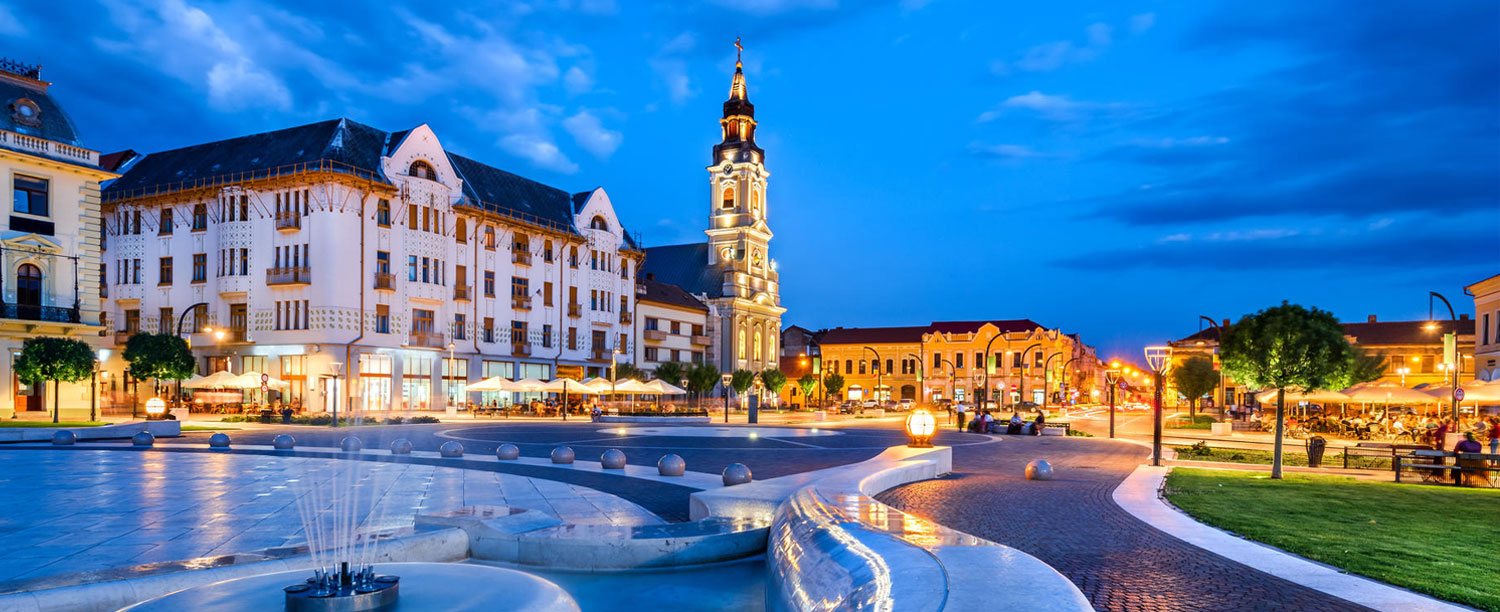
Piata Unirii (Union Square or the Little Square), took shape at the beginning of the 18th century when the areas became the centre of Oradea New Town. Beginning with 1753, the square underwent a series of transformations: monumental buildings in various architectural styles were erected, street lighting was introduced and the city’s first tram line – connecting the area with the railway station – was built. Seven architectural styles: Baroque, Classical, Eclectic, Historicist, Secession, Romantic and neo- Romanian can be admired while visiting Oradea’s most popular promenade area: the Union Square.
Oradea State Theater (Teatrul de Stat), a neoclassical structure that dominates the King Ferdinand Square (Piata Regele Fedinand), was designed in 1900 by Austrian architects Fellner and Hellmer, who also designed the Vienna Opera House.
Along one side of the King Ferdinand Square visitors can admire the undulating festoons and floral decorations of the Adorjan Houses (Casele Adorjan), built between 1907 and 1908 by Jakab and Komor, architects of the Black Eagle Palace.
Another exuberant art nouveau structure is the Moskovits building (Cladirea Moskovits), located at the corner of str. Independentei and str. Vasile Alecsandri. Designed by Kalman Rimanoczy Jr, the architect of the City Library and the Town Hall, it was completed in 1905.
Oradea's most imposing sight is the spectacular Oradea Fortress (Cetatea Oradea).
The present shape of the five-point-star fortress was given in 1569, when Italian military architect Domenico da Bologna was commissioned with rebuilding it after repeated invader attacks.
One of its interesting elements is a network of underground channels that were supplied by ducts of warm water during the winter.
Throughout the year the citadel is host to several art exhibitions and craft fairs.
Oradea Jewish Heritage
The first Jews settled in Oradea as early as the 15th century, making Oradea the site of one of the oldest and most important Jewish communities. Jewish people helped establish the city's chemical and milling industries as well as its transportation, communications and banking infrastructure. They also played important roles in the medical, academic and artistic institutions. By the 1940s, Oradea had 27 synagogues and a population of around 30,000 Jews. Annexed by Hungary during World War II, Oradea became the site of two ghettos, with the majority of the members deported to Auschwitz-Birkenau. Oradea has two large Neolog and Orthodox Jewish cemeteries.
Zion Synagogue
Sinagoga Neologă Sion
Address: Str. Independentei 22, Oradea
Designed by David Busch, chief architect of Oradea,
the Temple was commissioned by the Reform Jews, following their separation from the Orthodox Jewish community in 1870.
The Zion synagogue - completed in 1878 - is a, modernized, simplified replica of the Nuremberg (Germany) Synagogue (demolished in 1938).
The imposing 1000-seat temple has been recently restored and became an arts centre,
concerts, exhibitions, book launches, cultural and religious events are hosted at the synagogue.
Oradea Zion Synagogue more info
Great Temple
Address: Str. Mihai Viteazu 4, Oradea
The Moorish-style red brick and stucco design of Oradea Great Temple, built in 1890, is similar to that of the synagogue in town of Satu Mare (90 miles north-east).
Oradea Great Temple more info
Chevra Sas Synagogue
Address: Str. Crinului 2, Oradea
The smaller Sas Synagogue built in 1882, still serves the local Jewish community,
which currently numbers around 500 members and is one of the most active in the country.
Aachvas Rein Orthodox Synagogue (Teleki Synagogue)
This beautiful orthodox synagogue was the last Jewish house of worship built in Oradea, in 1928.
Left in disrepair for many decades, it served for a while as a vegetable warehouse for the street market just outside its doors.
The structure has recently been restored and, in December 2018, became the home of Oradea Museum of Jewish Heritage (Muzeul Istoriei Evreilor din Oradea).
Address: Str. Primariei 25
Oradea Jewish Community
Comunitatea Evreilor din Oradea & JCC Oradea
Address: Str. Mihai Viteazul 4
Telephone: (+4) 0259 434.843
...
» Oradea Jewish Heritage Walking Tour
When: available on selected days of the week
Tour starts: at 1 Decembrie Park (Parcul 1 Decembrie),
Main entrance - Strada Vasile Alecsandri
Please look for the red umbrella!
Tour ends: at Sinagoga Ortodoxă
Duration: two hours.
Cost: tips-based
Tips-based tours do not have a set ‘price’ and no upfront payment is required.
At the end of the tour each participant gives the guide the amount that she/he considers appropriate.
More info and reservations.
Please select date, then select time (right column, below date)
...
...
Oradea Museums
Museum of Crisana Region
Muzeul Tarii Crisurilor
Address: Blvd. Dacia 1 - 3
Telephone: (+4) 0259 412.724
Darvas – La Roche House
Casa Darvas – La Roche
An exquisite Art Nouveau monument inspired by Viennese architecture.
Address: Str. Iosif Vulcan 11
Open: Tue. -- Sun., noon – 7 p.m.
Treasury and Library of Roman - Catholic Diocese
Episcopia Romano - Catolica Oradea
Address: Sirul Canonicilor 2
Telephone: (+4) 0259 411.180
Oradea Roman - Catholic Diocese more info
10,000 books printed before 1800 and an impressive collection of objects of worship
are among items exhibited at the Museum of Oradea Catholic Diocese.
Poet Ady Endre Memorial Museum
Poet Muzeul Memorial Ady Endre
Address: Parcul Traian 1
Tel: (+4) 0259 463.755
Impressive collection of books, documents, manuscripts, periodicals, literary magazines and photos that belonged to Ady Endre, regarded by many as the greatest Hungarian poet of the 20th century.
Publisher Iosif Vulcan Museum
Muzeul Memorial Iosif Vulcan
Address: Str. Iosif Vulcan 14
Tel: (+4) 0259 463.755
Museum dedicated to journalist and writer Iosif Vulcan whose works depict Transylvania cultural lifes in mid-1800s.
Politician Aurel Lazăr Memorial House
Casa Memoriala Aurel Lazăr
Address: Str. Aurel Lazar 13, Oradea
Tel: (+4) 0259 442.112
Former residence of preeminent lawyer and politician Aurel Lazar;
on October 12, 1918 the Declaration of National Independence of Romanians, living in Transylvania, Banat, Crisana and Maramures regions,
was signed in this historic building.
...
Performing Arts
Oradea National Theatre
Teatrul Regina Maria – Oradea
Address: Piaţa Ferdinand I nr. 4 - 6
Telephone: (+4) 0259 436.592
Oradea Philharmony
Filarmonica Oradea
Address: Str. Moscovei 5
Telephone: (+4) 0259 430.853
Arcadia Puppet Theatre Ensemble
Trupa Arcadia – Oradea
Address: Piaţa Ferdinand I nr. 6
Telephone: (+4) 0259 440.742
Folk Ensemble “Nagyvarad”
Ansamblul Folcloric “Nagyvarad”
Address: Piaţa Ferdinand I nr. 6
Telephone: (+4) 0359 805.000
...
Oradea Local Beers:
Artisan beers produced in Oradea include:
Vulturar
and
Addictive.
...
Tourist attractions not far from Oradea
Ciuperca Public Garden - Oradea
Best views of Oradea are, perhaps, from Gradina Publica Ciuperca (Ciuperca Hill Public Garden).
The area has five observation decks and is popular with locals and visitors who want to see the city panorama,
to take a walk or to have a picnic not far from the city center.
...
Nymphaea AquaPark & Spa - Oradea
Parcul Acvatic Nymphea - Aquapark Nymphaea
Six pools (indoor and outdoor) of various sizes, five saunas, Turkish bath, water slides, whirpools, beauty salons, spa
and two restaurants are available to Oradea visitors and locals to relax and regain strength and energy at the Nymphaea Aqua Park & Spa.
The spa is open every day from 10 a.m. to 10 p.m.
...
Baile Felix thermal baths
Where: 5 miles south of Oradea
Access: car, bus
Established in the 18th century, Baile Felix is currently Romania's largest health town.
The thermal waters found here, very rich in oligominerals, and supplemented by sapropelic mud
alleviate rheumatism and arthritis as well as gynecological affections and neurological disorders.
Baile Felix info
...
Caves Stracoş and Tăşad
Cave Stracoş (Peştera Stracoş):
Where: Munții Pădurea Craiului (Mts.)
village Drăgeşti 20 miles SE of Oradea
Access: car, bus
Open to the general public
Phone reservation required to explore
More info
Cave Tăşad (Peştera Tăşad)
Where: Munții Pădurea Craiului (Mts.)
village Tasad - 16 miles SE of Oradea
Access: car, bus
More info
Note: Cave Tăşad is currently open to professional speleologists.
...
Day Trips from Oradea
Apuseni Mountains Nature Park
Parcul Natural Muntii Apuseni
Where: 64 miles southwest of Oradea
Access: car
Oradea makes a great base for exploring the stunning Apuseni mountains.
Apuseni Mountains Nature Park protects one of the most interesting cave systems in Romania.
Limestone underlies most of the park and is responsible for the area's landforms:
sculptured mountain ridges, underground rivers and more then 400 caves, many of which can be explored.
Rent a car in Oradea and take the scenic drive to Arieseni.
The Apuseni Motzi villages are ideal places to find the tranquility and timeless wisdom of traditional village life,
vibrantly alive and intact here as perhaps, nowhere else in Europe.
Where: 75 miles southwest of Oradea
Access: car, bus, train
Arad info
Sălacea - the village of 1,000 wine cellars
44 miles NE of Oradea, village Sălacea is home to 970 wine cellars, owned by the locals;
the number of cellars is greater than the number of houses in the village.
Dug into the hills surrounding the village, some of these brick cellars are over 250 years old.
Each cellar's wooden door features a distinctive design.
The area has a long viticulture tradition and it is especially known for its unique wine: Bakator, a white wine obtained from Bakator (Rujiță) grapes - a disease resistant native variety that ripens in late October or eary November.
In late 1800's Bakator wine used to be exported to Austria, for the Imperial Court.
The wine produced in NW Romania also traveled east; in 1871, 200 bottles of Bakator wine were delivered to the Chinese Imperial Court.
Where: 90 miles southeast of Oradea
Access: car, bus, train
Cluj-Napoca info
...
ORADEA TRIP PLANING INFO
Transportation
...
Air Travel to OradeaOradea International Airport (OMR)
Aeroportul International Oradea
Address: Calea Aradului 80, Oradea
Telephone: (+4) 0259 416.082
Oradea airport is located 3.1 miles southwest of the city centre.
Airlines with service to Oradea include:
Air Connect, Tarom, and RyanAir.
International airports not far from Oradea:
Arad (ARW) – 78 miles south
Cluj Napoca (CLJ) – 100 miles east
Timisoara (TSR) – 110 miles south
...
Oradea inter-city BusOradea Bus Stations
Autogara Oradea
Address: Str. Războieni 81
Telephone: (+4) 0259 418.998
Autogara CDI
Address: Str. Stefan cel Mare 4
Telephone: (+4) 0259 471.690
Autogara OTL
Address: Str. Griviței 36
Telephone: (+4) 0359 404.048
Daily domestic bus service from/to: major towns and cities in Romania and Central Europe as well as to/from villages in Bihor county.
...
Travel to Oradea by train
Oradea Train Station
Gara Oradea
Address: Str. Republicii 114, Oradea
Tel: (+4) 0259 444.952
The train station is located about 1.2 miles from downtown. Tram # 1 and 4 run south from Piata Bucuresti (just outside of the train station) to Piata Unirii, Oradea's main square.
There are daily trains from/to Budapest (Hungary) (travel time – 4 hours).
For a list of international trains to/from Romania please visit
RomaniaTourism International Transportation section
| City of departure | Travel Time to Oradea |
|---|---|
| Arad | 2h 55min |
| Baia Mare | 3h 20min |
| Bucharest | 13h 35min |
| Budapest (Hungary) | 6h 25min |
| Brasov | 10h 55min |
| Cluj - Napoca | 3h 50min |
| Debrecen (Hungary) | 3h 15min |
| Satu Mare | 2h 5min |
| Sibiu | 8h 10min |
| Sighisoara | 9h 45min |
| Timisoara | 4h 10min |
| Vienna (Austria) | 9h 25min |
| ... | Schedules and Reservations |
Oradea Train ticket office
Agentia SNCFR Oradea
Address: Str. Roman Ciorogariu 4,
Tel: (+4) 0259 416.565
Open:
Mon. - Fri. 8 a.m. – 8 p.m
Baia Mare SNCFR ticket office offers train information and tickets for future travel.
Tickets for same-day travel can only be purchased at the train station.
...
Reaching Oradea by carThe fastest route from Bucharest to Oradea is via A1 / E81 - E68 - E79 / DN76:
Bucuresti – Pitesti – Ramnicu Valcea – Sibiu – Sebes – Deva - Beius – Oradea
Driving route from Budapest (Hungary) to Oradea:
E60 - E671 / E 69: Budapest – Szolnok – Oradea
| Road Distance from/to Oradea: | |
|---|---|
| City | Distance |
| Bucharest | 380 miles |
| Arad | 75 miles |
| Baia Mare | 120 miles |
| Brasov | 265 miles |
| Budapest (Hungary) | 170 miles |
| Cluj-Napoca | 95 miles |
| Constanta | 545 miles |
| Iasi | 360 miles |
| Sibiu | 190 miles |
| Sighisoara | 190 miles |
| Suceava | 285 miles |
| Targu Mures | 160 miles |
| Timisoara | 110 miles |
| Vienna (Austria) | 310 miles |
...
Oradea Public TransportationEight tramway and 20 bus routes connect Oradea's main areas and tourist attractions.
Cost of a single ticket for Oradea tram or bus is 3 Lei (approx. $0.75)
Price of a return ticket (2 trips) is 5 Lei (approx. $1.25)
| Oradea Taxi Companies | |
|---|---|
| Name | Phone # |
| Taxi Fulger | (+4) 0788 887.787 |
| City Taxi | (+4) 0744 777.111 |
| Hello Taxi | (+4) 0725 254.214 |
| Taxi Start | (+4) 0745 999.940 |
| Green Taxi | (+4) 0745 254.214 |
...
Oradea Car Rental CompaniesGreat Oradea car rental rates.
Avis - Oradea Airport
Tel: (+4) 0259 425.242
Budget
Tel: (+4) 0259 432.888
Promotor Rent a Car
Tel: (+4) 0734 403.403
Rent a Car Oradea
Tel: (+4) 0359 303-106
Sixt - Oradea Airport
Tel: (+4) 0744 499.400
...
Book your 'tips-based' Oradea Walking Tour, three available.
Tip-based tours do not have a set ‘price’ and no upfront payment is required.
At the end of the tour each participant gives the guide the amount that she/he considers appropriate.
...
Oradea Bus Tour
Autobuzul Cabrio
Availability: Every weekend - top of the hour from 1 p.m. to 7 p.m.
Tour starts at: Piața Unirii, in front of Biserica cu Lună.
Route length: 11 miles
Tickets: 10 lei (adult) / 5 lei (child), are available from the driver.
Bus is accessible to passengers with limited mobility / using mobility devices.
Guidance is offered in four languages, every seat has a headphone jack.
Route/Stops:
Piaţa Unirii – Universitatea Partium – Autogara Decebal – Grădina Zoologică –
Muzeul Ţării Crişurilor – Oficiul de Cadastru – Universitate – Cimitirul Rulikowski – Universitate –
Oficiul de Cadastru – Muzeul Ţării Crişurilor – Biserica cu Lună – Piaţa 1 Decembrie/Bloc Turn –
Centrul Civic/CEC – Magazinul Crişul – Şirul Canonicilor – Gara Centrală – Episcopia Ortodoxă –
Parcul Traian – Iosif Vulcan – Piaţa Ferdinand – Piaţa Unirii.
...
Oradea Hotels
Accommodations in Oradea include:
| Hotel Name | Class | Location |
|---|---|---|
| Astoria Grand | boutique / upscale | Oradea city centre |
| Nevis | four-star / uppermidscale | one mile northwest of Oradea city centre |
| Glory | four-star / upscale | one mile west of Oradea city centre |
| Continental Forum | four-star / midscale | Oradea city centre |
| Mercure | four-star / uppermidscale | 1.2 miles south of city centre |
| Double Tree | four-star / uppermidscale | city centre |
| Ramada by Wyndham | four-star / uppermidscale | 0.5 miles west of Oradea city centre |
| Novotheos | four-star / midscale | 0.2 miles north of Oradea city centre |
| Maxim | three-star/ midscale | 0.2 miles north of Oradea city centre |
| Impero | three-star/ midscale | 0.5 miles west of Oradea city centre |
...
Oradea Tourist Info
Oradea Tourist Information Centre
Centrul de Informare Turistica - Oradea
Address: Piața Emanuil Gojdu 39 - 41. Corp J
(inside Oradea Fortress / Cetatea Oradea)
Telephone: (+4) 0359 191.096
E-mail
VisitOradea.com
Hours:
May through September: daily from 9 a.m. to 5 p.m.
October through April: daily from 8 a.m. to 4 p.m.
Oradea City Pass, an initiative of Visit Oradea / Oradea City Hall
Visitors who stay two or more nights in an Oradea participating hotel will enjoy:
~ Free admission at participating city museums,
~ Free Oradea public transport pass, valid 24 hours,
~ Discounts at participating cafes and restaurants.
...
Oradea Local Authorities
Oradea / Bihor County ArchivesDirectia Judeteana Bihor a Arhivelor Nationale
Address: Str. Traian Blajovici
Oradea, postal code 410076
Telephone: (+4) 0259 413.876
E-mail
Hours
Oradea City Hall
Primăria Municipiului Oradea
Address: Piata Unirii 1
Telephone: (+4) 0259 437.000
Oradea Consumer Protection Agency
Comisariatul Judeţean pentru Protecţia Consumatorilor Bihor
Address: Str. Evreilor Deportați 4 A
Telephone: (+4) 0259 431.817
Oradea Main Post Office
Posta Oradea
Address: Str. Roman Ciorogariu 12
Tel: (+4) 0259 431.342
Post office signs display the word POSTA.
Telephoning Oradea from Abroad:
International Access Code + 4 (country code) + 0259 or 0359 (area code) + six-digit telephone number
...
Oradea Health Care and Emergency
General Emergency Telephone number: 112
Ambulance (Ambulanta), Police (Politia), Fire Department (Pompieri)
Pharmacies (Farmacie) open 24 hours a day in Oradea include:
| Name | Address | Telephone # |
|---|---|---|
| Elixir | Strada Tudor Vladimirescu 4 | (+4) 0766 243.387 |
| Farmimpex | Calea Republicii 26 | (+4) 0259 430.820 |
| Concordia | Piata Bucuresti 2-4 | (+4) 0259 449.318 |
| MediFarm | Str. Ialomitei 1, Bl. AN3 | (+4) 0259 433.192 |
| Sanifarm 58 | Calea Republicii 33 | (+4) 0359 805.408 |
| Sfânta Maria | Str. Transilvaniei 16 | (+4) 0259 443.779 |
| Biovita | Calea Republicii 40 | |
| Farmacia 68 | Str. Progresului 30-31 |
...
Oradea Hospitals
| Name | Address | Telephone # |
|---|---|---|
| Oradea Emergency Clinic Hospital Spitalul Clinic Judetean de Urgenta |
Calea Republicii 37 | (+4) 0359 173.250 |
| Oradea Municipal Hospital Spitalul Clinic Municipal “Dr. Gavril Curteanu” |
Str. Corneliu Coposu 12 | (+4) 0359 803.800 |
| Railways Company Hospital Spitalul Clinic CFR Oradea |
Str. Republicii 56 | (+4) 0259 411.581 |
| Oradea Clinic Hospital „Pelican” Spitalul Pelican |
Str. Corneliu Coposu 2 | (+4) 0259 444.444 |
| Oradea Military Hospital Spitalul Clinic de Urgenta “Avram Iancu” |
Str. Dunărea 3 | (+4) 0359 427.610 |
...
Oradea Maps
Oradea City Centre Map (Harta zonei centrale a municipiului Oradea)
City of Oradea interactive Street Map (Harta Interactiva Oradea)
Romania Physical Map (Romania - Harta Fizica)
Romania Main Roads and Tourist Attractions Map ( Romania - Harta Atractii Turistice)
Romania Road Map (Romania - Harta Drumurilor si Soselelor)
Romania Railways Map (Romania - Harta Cailor Ferate)