People I Religions I Language I Romania Public Holidays
People of Romania
Over 20 million people live in Romania and almost 6 million live abroad,
many taking advantage of the benefits offered by
double citizenship.
Countries that have attracted large numbers of Romanian nationals include Italy, Spain, the United Kingdom, Germany and the United States of America.
Ethnic breakdown of Romania's population is: Romanian 89%, Hungarian 7.5% , Gypsy 1.9% , German, Ukrainian, Armenian, Croatian, Serbian, Tatar and Turkish.
Foreign visitors consider Romanians among the friendliest and most hospitable people on earth.
Romanians are by nature fun loving, warm, hospitable, playful, with an innate sense of humor.
Volunteering in Romania
is one of the best ways to experience local culture.
Romania is associated with big names in arts and sports:
Constantin Brâncuși (1876 - 1957) — the artist whose works redefined sculpture, the most important sculptor of the Twentieth-Century. Considered by many the Father of Abstract Sculpture, Brâncuși's work has profoundly influenced the modern concept of shape in sculpture, paining and drawing.
(excerpt, Brancusi 1938 interview)
...
Sergiu Celibidache
(Celibidachi) - conductor, composer, musical theorist, and professor.
A philosopher of universal music, Sergiu Celibidachi
is widely considered one of the greatest and most uncompromising conductors of the 20th century.
His quest for unparalleled precision and acoustic clarity was not always understood
or popular among other conductors and members of an orchestra.
During his over 50 years career, Celibidache lead
the Berlin Philharmonic Orchestra, RAI National Symphony, Orchestre de Radio France,
the Swedish Radio Symphony Orchestra, the Danish National Radio Symphony,
the London Symphony Orchestra, and the Munich Philharmonic Orchestra -
the orchestra he became most associated with over the final decade of his life.
Celibidache dedicated his time to teaching at several notable music institutions:
the Accademia Musicale Chigiana in Siena, Italy, Mainz University in Germany,
the Curtis Institute of Music in Philadelphia, USA,
and at the Schleswig-Holstein Musik Festival in Germany.
Film The Yellow Tie
explores Celibidache's singularity of character and ambition, as well as his musical idiosyncrasies.
(EuroArts.com)
Celibidache conducts the symphony as though it were a masterwork, and, through such care, it almost becomes one.
He could lift obscure orchestras—and he lifted many of them,
in a peripatetic career—he could lift obscure (sometimes deservedly obscure) pieces.
(Jay Nordlinger -
Great Conductors)
...
Winner of Grammy Award for Best Instrumental Soloist Performance,
pianist Radu Lupu
is widely recognized as one of the greatest pianists of his time.
Lupu was frequently cited by fellow musicians as an inspiration and model of artistic expression,
particularly for his interpretations of Schubert, Brahms, Mozart, Beethoven and Bartok, among other composers.
"If there's one pianist who challenges you to hear classical music in a whole new way, it's Radu Lupu.
Since winning the Van Cliburn Competition in 1966, he's gained a loyal following for his idiosyncratic interpretations
that always explore the complex emotions behind the music".
(attribution: CarnegieHall.org)
"Lupu's "singing tone here must be heard to be believed.
Without belittling the other facets of Schubert's musical personality,
he captures the composer's songful essence with a rare beauty – and, in so doing,
does ample justice to the music of the past."
(attribution: The New York Times)
...
Mircea Eliade - historian of religion, fiction writer, philosopher, and professor.
...
Dramatist Eugen Ionesco, one of the foremost figures of the avant-garde theatre.
...
Composer, violinist and conductor George Enescu .
"He will remain for me the absoluteness through which I judge others".
He also considered Enescu "the most extraordinary human being, the greatest musician and the most formative influence" he had ever experienced”.
...
Pan flute virtuoso Gheorghe Zamfir.
Known as "Master of the Pan Flute", Zamfir introduced the folk instrument to a modern audience and revived it from obscurity.
He plays an expanded version of normally 20-pipe pan flute (nai in Romanian),
with 22, 25, 28 or even 30 pipes, to increase its range, and obtaining as many as eight overtones from each pipe.
...
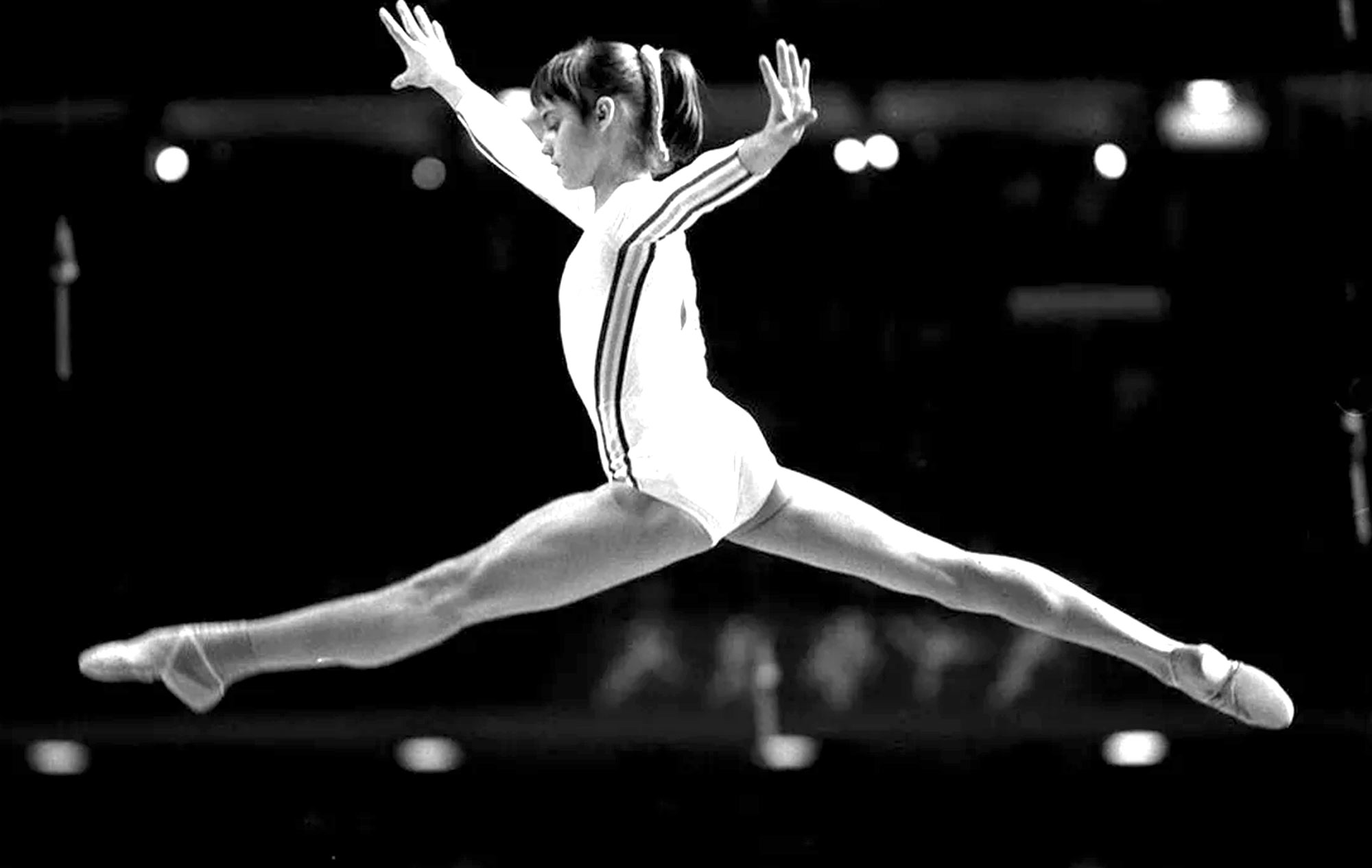
Nadia Comăneci
— the gymnastics legend who stunned the world with her skills on the uneven bars,
the first in the world to score a perfect 10.
Nadia is practically single-handedly responsible for the popularity of gymnastics as a sport,
thanks to sweeping the Olympics for gold medals in her youth.
...
Opera performer, soprano Angela Gheorghiu
"The world's most glamorous opera star" (New York Sun)."
"…perhaps the most instantly recognizable and interesting soprano voice of our time…
a liquid instrument of great beauty" (Gramophone).
...
Alexandra Nechita — a young Romanian painter living in California, known for her distinct style.
...
Ilie Năstase — Twice ranked as the world's number one men's player in the early 1970s, Ilie Nastase won two Grand Slam singles titles during his illustrious career: the US Open in 1972 and the French Open in 1973.
Life and work of sculptor Constantin Brâncuși
six-minutes video by award winning
broadcaster and historian
Tessa Dunlop
More about truly remarkable Romanians.
...
Abut 55% of Romania's population lives in urban areas
(there are 230 large towns, 25 cities with a population of more than 100,000
and 8 cities with more than 300,000 inhabitants)
while 45 % of Romanians have their main residence in rural areas
(2,868 communes and 13,285 villages).
The main administrative divisions are called "județ" (county).
There are 41 counties in Romania.
The capital city, Bucharest (Municipiul Bucuresti), has the status of a county.
...
Main religions in Romania
Eastern Orthodox 78%
Greek Catholic 10%
Roman Catholic 5%
Protestant 5%
Unitarian,
Jewish,
other
...
Romanian Language
Romanian, a Latin based language which is a continuation of the Latin
spoken in ancient times in Dacia and Moesia - the eastern provinces of the Roman Empire.
A 31-letter Latin alphabet is in use.
Ethnic minorities (Hungarian and German) use their own languages in school and civil administration.
Literacy rate in Romania is 98%.
Many Romanians living in towns and cities are able to communicate in English, French or German.
In smaller villages only younger people and children usually speak foreign languages.
Around 80% of Romanians speak one foreign language, 25% speak two and
4% speak three or more foreign languages.
Romania has over 100 universities;
every year over 30,000 students get their engineering degree and 8,000 earn their degrees in IT sciences
For more information about Romanian language, a pronunciation guide and useful words and phrases please visit
RomaniaTourism Romanian Language section.
RoLang offers the posibility to learn Romanian in Romania/ take Romanian Language Classes.
...
Romania Public Holidays
| Public Holidays in Romania | |
|---|---|
| January 1 and 2 | New Year |
| January 6 | Epiphany |
| January 7 | St. John the Baptist Day |
| January 24 | Union of Romanian Principalities Wallachia and Moldova |
| February 19 | birthday of artist Constantin Brancusi |
| March, April or May (date varies) | Orthodox Good Friday |
| March, April or May (date varies) | Orthodox Easter Monday |
| May 1 | Labor Day |
| May or June (date varies) | Whit Monday (Rusaliile) celebrated 50 days after the Orthodox Easter |
| June 1 | Children's Day |
| August 15 | The Dormition of the Theotokos / Assumption of Mary (Sfanta Maria) |
| November 30 | Saint Andrew Day (Sfantul Andrei) |
| December 1 | National Day of Romania |
| December 25 and 26 | Christmas |
Dates of Orthodox Good Friday (Vinerea Mare), Easter (Paștele Ortodox) and Whit Monday (Rusaliile)
| Year | Good Friday | Easter | Whit Monday |
| 2027 | April 30 | May 2 and 3 | June 21 |
| 2028 | April 14 | April 16 and 17 | June 5 |
| 2029 | April 6 | April 8 and 9 | May 28 |
| 2030 | April 26 | April 28 and 29 | June 17 |
| 2031 | April 1 | April 3 and 14 | June 2 |
| 2032 | April 30 | May 2 and 3 | June 21 |
| 2033 | April 22 | April 24 and 25 | June 13 |
| 2034 | April 7 | April 9 and 10 | May 29 |
| 2035 | April 27 | April 29 and 30 | June 18 |
Some of the information above may be preliminary. Please do let us know if you find inexactitudes.
According to the Greek Orthodox Church, nearly every day of the year is dedicated to the memory of at least one Christian saint or martyr. If someone is named after a saint, that day becomes her / his name day (Ziua Onomastica or Ziua Numelui) and, traditionally, is celebrated.
Several religious holidays including:
feast of St. George (Sfantul Gheorghe) - April 23,
feast of Sts. Peter & Paul (Sfintii Petru si Paul) - June 29,
feast of St. Mary (Sfanta Maria) - August 15,
feast of St. Michael (Sfantul Mihai) - November 8
and St. Nicholas (Sfantul Nicolae) - December 6,
are observed throughout the year in rural areas.
Ethnic minorities celebrate their own religious and commmunity holidays.