



Romania's Castles and Fortresses
Please read the updated version of this page at RomaniaTourism.com/ Castles&Fortresses
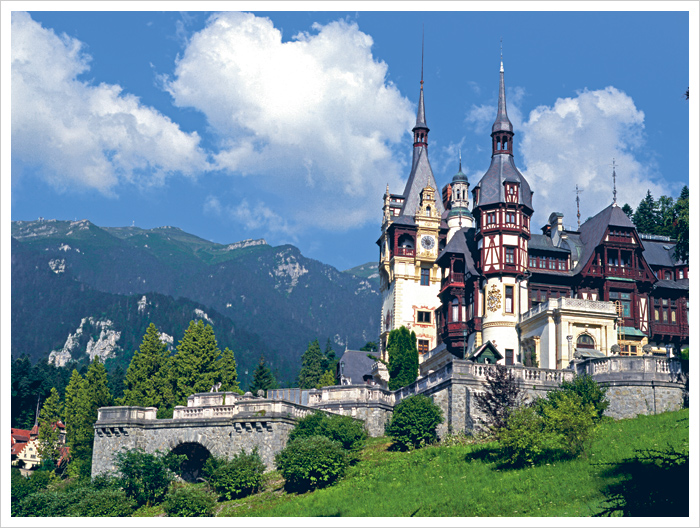
Romania's collection of castles and fortresses perhaps best illustrates the rich medieval heritage of the country. While castles built from the 14th to the 18th centuries are strong and austere fortresses built mainly for defense against invaders, those erected beginning in the late 1800s are imposing and luxurious. The most popular include the 14th century Corvinesti Castle, built on the site of a former Roman camp, the elegant 19th century Peles Castle with its 160 rooms filled with priceless European art and, of course, the Bran Castle, built in the mid-1300s and legendary home to Bram Stoker's Count Dracula.
As a result of almost nine centuries of Saxon presence, Transylvania, located in central Romania, claims a cultural and architectural heritage unique in Europe. This region is home to nearly 200 Saxon villages, churches and fortifications built between the 13th and 15th centuries. Seven of the fortified Saxon churches (in Biertan, Calnic, Darjiu, Prejmer, Saschiz, Valea Viilor, and Viscri) were designated by UNESCO as World Heritage Sites. A visit to these quaint villages, placed amidst lush farmland and green rolling hills, will give you a taste of the long-gone medieval times.
Explore some of Romania's best-known castles and fortresses:
Biertan Fortified Church
(UNESCO World Heritage Site)Location: Transylvania – Central Romania
Nearby large town: Sighisora (18 miles east)
Nearest train station: Dumbraveni
Telephone: (269) 806.699
Email: office@biertan.ro
Web: www.Biertan.ro
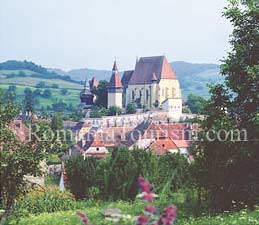
The village of Biertan (German: Birthalm), first mentioned in an official document in 1283, is home to one of the largest and most impressive medieval strongholds in Transylvania.
Surrounded by quaint streets and vineyards, the 15th century fortified church at Biertan is perched high on a hill in the middle of the village. Three tiers of 35-foot-high defensive walls, connected by towers and gates, encircled the complex, making the church impossible to conquer during medieval times.
Featuring late-gothic architecture with heavy doors and double exterior walls, the church boasts the largest Transylvanian multi-paneled wooden altar and a remarkable wooden door which once protected the treasures in the sacristy. The altar was built by artisans from Vienna (Austria) and Nurenberg (Germany) between 1483 and 1513. The door, a true marvel of engineering, has a particularly ingenious locking mechanism with 15 bolts that can be simultaneously activated by a key. The mechanism stirred quite an interest at the Paris World Expo in 1900.
The church's organ features some 1,290 pipes, as well as 25 registers, and was built in 1869 by the Hessian Company in Vienna.
Visitors can also admire the towers surrounding the church, namely the Clock Tower, the Bell Tower, the Gate Tower and the Bacon Tower. Within the grounds are several other interesting buildings, including the Prison Tower - which once served marital counseling purposes.
From 1572 to 1867, Biertan was the seat of the Saxon Evangelical bishops of Transylvania; their fine gravestones can be seen inside the Bishops' Tower.
Bran Castle
Location:
Transylvania – Central Romania
Nearby large town:
Brasov (16 miles northeast)
Nearest train station: Brasov
Address: Str. Traian Mosoiu 24, Bran
Telephone: (268) 237.700 or 237.701
Email: office@bran-castle.com
Web: www.Bran-Castle.com
Open:
May 1 - September 30
Monday: 12:00 pm - 6:00 pm
Tuesday - Sunday: 9:00 am - 6:00 pm October 1 - April 30
Monday: 12:00 pm - 4:00 pm
Tuesday - Sunday: 9:00 am - 4:00 pm
Admission charge: www.Bran-Castle.com/en/Information/Pretul_Biletului
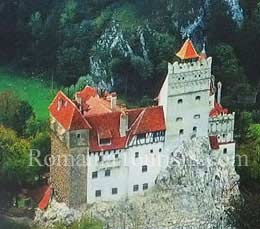
Surrounded by an aura of mystery and legend and perched high atop a 200-foot-high rock, Bran Castle owes its fame to its imposing towers and turrets as well as to the myth created around Bram Stocker's Dracula.
Built on the site of a Teutonic Knights stronghold dating from 1212, the castle was first documented in an act issued by Louis I of Hungary on November 19, 1377, giving the Saxons of Kronstadt (Brasov) the privilege to build the Citadel.
Although Stoker never visited Transylvania, the Irish author relied on research and his vivid imagination to create the dark and intimidating stomping ground of Count Dracula, leading to persistent myths that it was once the home of Vlad Tepes, ruler of Walachia. While the association with Dracula is sketchy at best, the castle continues to hold a strong attraction for all fans of the Count.
From 1920 to 1957 Bran served as royal residence, a gift of the people of Brasov to Queen Marie of Romania. The castle is now a museum open to tourists, displaying art and furniture collected by Queen Marie.
Narrow winding stairways lead through some 60 timbered rooms, many connected by underground passages, which house collections of furniture, weapons and armor dating from the 14th to the 19th centuries. The castle overlooks the picturesque village of Bran, which offers an open-air Ethnographic Museum consisting of old local-style village houses complete with furniture, household objects and costumes.
Nearby attractions: Rasnov Fortress (7 miles); Brasov (16 miles); Peles Castle in Sinaia (35 miles); the ski resorts in Poiana Brasov (10 miles) and Predeal (15 miles); the medieval cities of Sighisoara (88 miles) and Sibiu (96 miles); Bucharest (110 miles).
Accommodations near Bran Castle:
http://Carta.ro/Cazare-Bran
http://Carta.ro/Cazare-Moeciu/
Calnic Fortified Church
(UNESCO World Heritage Site)Location: Transylvania – Central Romania
Nearby large town: Sibiu (30 miles southeast)
Nearest train station: Miercurea Sibiului
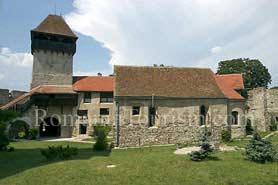
Built in the 13th century by Count Chyl de Kelling, the Fortified Church at Calnic (German: Kelling) is one of the most imposing defensive structures in Transylvania. First mentioned in a 1269 document, the fortress served as a residence for Saxon nobility until 1430, when it was sold to the peasant community of Calnic.
Enclosed by one and a half rings of high walls fortified with a defensive tower to the south and a gate tower to the north, the fortress withstood several Ottoman sieges. Its defense system was completed in the 16th century when a small Romanesque chapel, surrounding walls and a water ditch were added by the Calnic community.
The five-story-high Siegfried Tower, the landmark of the fortress, is endowed with defensive corridors and firing windows. An on-site medieval art museum displays various artifacts.
Cisnadie Fortified Church
Location: Transylvania – Central Romania
Nearby large town: Sibiu (6 miles north)
Nearest train station: Sibiu
Originally built in the 12th century as a Romanesque basilica, the church was fortified during the 15th century to protect the local Saxon population against repeated Ottoman raids. The fortification process included the construction of fortified towers over the two side entrances and the choir, the building of a double structure of defense walls, a moat and several defensive towers along the walls.
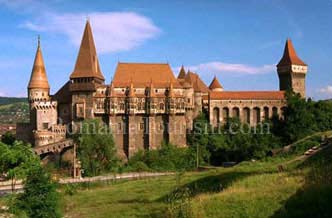
Corvinesti Castle
Location:
Hunedoara – Central Romania
Nearest train station: Hunedoara
Address:
Str. Castelului 1, Hunedoara
Telephone: (254) 711.423
Email: contact@castelulcorvinilor.ro
Web: www.CastelulCorvinilor.ro
Open:
(May – August)
Tue. – Sun. 9:00 a.m. – 6:00 p.m.;
Mon. 9:00 a.m. – 3:00 p.m.
(March – April)
Tue. – Sun. 9:00 a.m. – 5:00 p.m.;
Mon. 9:00 a.m. – 3:00 p.m.
(September – February)
Tue. – Sun. 9:00 a.m. – 4:00 p.m.; Mon. 9:00 a.m. – 3:00 p.m.
Admission charge
The greatest Gothic-style castle in Romania, Corvinesti was built by the Anjou family on the site of a former Roman camp. The castle served as a fortress until the mid-14th century when it became the residence of Transylvania's ruler, Iancu de Hunedoara. Iancu upgraded the fortress transforming it into the most stunning castle in Transylvania.
The beautifully preserved structure features a sumptuous Knights' Hall, an impressive drawbridge, high buttresses, inner courtyards, a chapel and some 50 rooms resplendent with medieval art. The courtyard features a 100 ft. well dug into stone.
Cristian Fortified Church
Location: Transylvania – Central Romania
Nearby large town: Sibiu (7 miles east)
Nearest train station: Sibiu
The gothic-style Evangelical Church (1495) in the village of Cristian stands on the site of a 13th century Roman basilica. Built in the 16th century, the church is enclosed by two rows of walls guarded by towers. Two underground tunnels allowed villagers to flee from the fortress to the forest or to an old monastery in times of siege.
Darjiu Fortified Church
(UNESCO World Heritage Site)Location: Transylvania – Central Romania
Nearby large town: Sighisoara (20 miles west)
Nearest train stations: Saschiz h, Sighisoara
The fortified church at Darjiu was initially built in Roman style in the 14th century, and later rebuilt in gothic style. It was fortified in the 16th century when locals drew inspiration from the fortified churches of neighboring Saxon villages. The Gate Tower preserves its initial form, with openings for shooting missiles; wooden shutters provided protection against incoming projectiles. The original interior frescoes, some of the most impressive Transylvanian medieval works, have been preserved.
The wall around the church, which served as defense against Ottoman attacks, was not as high as those surrounding most Saxon fortified churches since the village, itself, was situated high on a hill. Today, only a small section of the wall built in 1520 remains.
Residents still keep their grain in barns inside the fortress, whereas bacon and ham are kept in the fortress towers. Grain may be picked up every morning, but bacon only once a week.
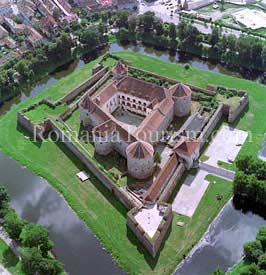
Fagaras Fortress
Location: Transylvania – Central Romania
Nearby large towns: Sibiu (44 miles west) and Brasov (45 miles east)
Nearest train station: Fagaras
Open: Tue. – Fri. 9:00 a.m. – 4:00 p.m.;
Sat. – Sun. 9:00 a.m. – 3:00 p.m.;
Closed Mon.
Admission charge
Built in 1310 on the site of a former 12th century wooden fortress (burned by the Tartars in 1241), Fagaras was enlarged between the 15th and 17th centuries and was considered one of the strongest fortifications in Transylvania. The fortress was surrounded by a deep moat which, in times of war or social unrest, could easily be filled with water from a nearby mountain brook. A bridge over the moat provided the only access point. The fortress boasts three floors and five towers.
Throughout the years, Fagaras Fortress functioned mainly as a residence for various princes and their families. Transylvanian Prince Gabriel Bethlen (1613-1629), strongly influenced by the Italian Renaissance, brought architects and glassmakers from Italy who rebuilt the fortress, bestowing elegance and beauty to the construction. During the rule of Georg Rákóczi (1630-1649), the castle's fortifications were doubled and the moat was enlarged. Ráckózi had the bastions bridged and covered, the moat paved with stones, the bridge and the casemates repaired and a guardhouse built.
Records show that the interior must have been luxurious in the 17th century; unfortunately, little of its former grandeur has been preserved. The castle was deprived of its decorations and fancy furniture when it was turned into a military garrison in the 18th century.
Today, the beautifully preserved fortress houses the Fagaras County Museum, displaying Roman artifacts, a collection of medieval weapons and traditional folk crafts. The museum also hosts a beautiful collection of icons painted on glass.
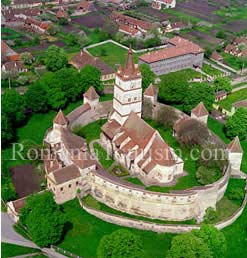
Harman Fortified Church
Location: Transylvania – Central Romania
Nearby large towns: Brasov (4.5 miles south)
Nearest train stations: Brasov, Prejmer
Located in the heart of Harman (Honigburg in German, meaning Honey Castle) village, this fortified church dates back to the 13th century when Saxons built the original structure. Strong walls and bulwarks surrounded the church and on its sides, massive towers were added.
The choir was built in a square shape with a vault resembling a cross. It was surrounded by two chapels, indicating the influence of the Cistercian style. This influence can also be observed in the still-standing original round windows with four lobes in the upper part of the church. The fortified church boasts two chapels.
The south chapel has been preserved in its initial state while the north chapel was rebuilt in the 15th century. The exterior vaults of the chapel are sculptured in stone and have a human face at each end.
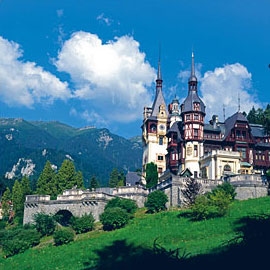
Peles Castle
Location: Sinaia – Southern Romania
Nearby large towns:
Brasov (40 miles north)
and Bucuresti (80 miles south)
Nearest train station: Sinaia
Address: Str. Pelesului 2
Telephone: (244) 310.918
Email: peles.ro@gmail.com
Web: www.peles.ro
Open: ( September to May)
Wed. 11:00 a.m. – 5:00 p.m.;
Thu. – Sun. 9:00 a.m. – 4:00 p.m.; Closed Mon. & Tue.
(May to September)
Tue. – Sun. 9:00am – 5:00pm; Closed Mon.
Note: Peles Castle is closed during the entire month of November
Admission charge
Nestled at the foot of the Bucegi Mountains in the picturesque town of Sinaia, Peles Castle is a masterpiece of German new-Renaissance architecture, considered by many one of the most stunning castles in Europe.
Commissioned by King Carol I in 1873 and completed in 1883, the castle served as the summer residence of the royal family until 1947. Its 160 rooms are adorned with the finest examples of European art, Murano crystal chandeliers, German stained-glass windows and Cordoba leather-covered walls.
The castle draws its name from neighboring Peles Creek, which passes right through the courtyard.
The first movie projection in Romania took place in 1906 in the castle's Theater Hall.
The furniture in the Music Room is carved of teak, a gift to King Carol I from the Maharajah of Kapurtala in India, while handmade silk embroideries adorn the ceiling and walls of the Turkish Salon. The ceiling paintings and decorative frescoes in the Theater Hall were designed by the renowned Austrian artists Gustav Klimt and Frantz Matsch. Over 4,000 European and Oriental pieces dating from the 15th to the 19th centuries are on display in the armories.
King Ferdinand, who succeeded Carol I, commissioned the smaller, art nouveau-style Pelisor Castle nearby. Pelisor's 70 rooms feature a unique collection of turn-of-the century Viennese furniture and Tiffany and Lalique glassware.
Also worth exploring in town is Sinaia Monastery, founded by Prince Mihai Cantacuzino in 1695, and named after the great Sinai Monastery on Mount Sinai. The monastery served as the residence of the royal family until Peles Castle was built, and now is home to a monastic establishment.
Sinaia, a well-known ski resort, and the surrounding towns of Busteni, Azuga and Predeal provide many facilities for an active vacation – from ski and hiking trails to wildlife viewing.
Nearby attractions: Rasnov Fortress (28 miles); Bran Castle (35 miles); Brasov (40 miles); the ski resorts in Predeal (14 miles) and Poiana Brasov (35 miles); Bucharest (78 miles); the medieval cities of Sighisoara (88 miles) and Sibiu (105 miles).
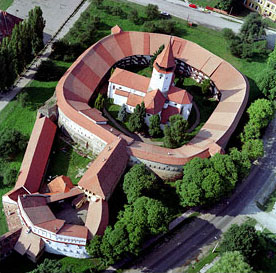
Prejmer Fortified Church
UNESCO World Heritage Site)Location: Transylvania – Central Romania
Nearby large towns: Brasov (11 miles southwest)
Nearest train station: Prejmer
The largest fortified church in southeastern Europe, Prejmer
(Tartlau in German) was built by Teutonic knights in 1212-1213. The powerful surrounding walls are 40 feet high and 10-15 feet thick. Historical records attest that in its 500 years of existence, the fortress was besieged 50 times. However, it was only captured once, in 1611 by Gabriel Báthori, Prince of Transylvania.
Endowed with bastions, drawbridges and a secret, subterranean passage through which food supplies could be transported, the church's most famed war device was the "death machine," made of several weapons that could shoot simultaneously, causing the enemy severe losses.
Access to the building was through a 100-foot-long arched passage fortified with two rows of gates. Each village family had a designated room for shelter in case of attack. The red-roofed wall accommodated 272 rooms, stacked over four stories and linked by wooden staircases.
The church, built in a cross-like plan, was completed in 1225 and later adapted to the Cistercian style. The nave features late-gothic vaulting.
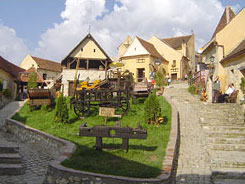
Rasnov Fortress
Location: Transylvania – Central Romania
Nearby large towns: Brasov (9 miles northeast)
Nearest train station: Brasov
Admission charge
Rasnov Fortress (Rosenau in German), is located on a rocky hilltop in the Carpathian Mountains, 650 ft. above the town of Rasnov. First mentioned in an official document in 1331, the fortress was built by Teutonic Knights as protection against invading Tartars and was later enlarged by the local Saxon population. Strategically located on the commercial route linking the provinces of Transylvania and Walachia, Rasnov differs from other Saxon fortresses in that it was designed as a place of refuge over extended periods of time. As such, it had at least 30 houses, a school, a chapel and other buildings more commonly associated with a village.
Work on the 470-foot-deep well began in 1623 and took 17 years to complete. The well provided extra security as it meant the people didn't have to go outside the gates at all during a siege. It was in use until 1850 when the wheel broke.
The defensive system included nine towers, two bastions and a drawbridge. Surrounded by 500-foot-slopes on the north, south and west sides, the fortress was obliged to surrender only once, in the year 1612 when invaders managed to find the secret route that supplied the people inside the fortress with water. With the location of their water supply no longer a secret, the need for a well inside the fortress became a must.
The last siege of Rasnov Fortress took place in 1690 during the final Ottoman invasion of Transylvania. Damaged by fire in 1718, it was rebuilt the following year. The next major damage occurred as the result of an earthquake in 1802. The fortress was last used as a place of refuge during the revolution of 1848 and was abandoned after that.
Recently, the old fortress has been restored to its former glory and today, you can visit the impressive remains. There is also a museum here, hidden behind the ancient walls, where you can find a skeleton buried beneath a glass floor, as well as some other interesting artifacts.
The inner rooms are maze-like, with several wooden ladders linking them and a few so-called secret passages which should keep you busy for quite awhile.
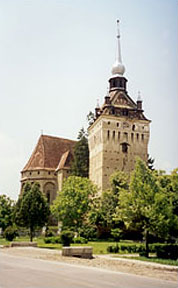
Saschiz Fortified Church
(UNESCO World Heritage Site)
Location: Transylvania – Central Romania
Nearby large town: Sighisoara (10 miles west)
Nearest train station: Saschiz h
Telephone: 744 020.337
Web: www.saschiz.ro/en/index.htm
Saschiz is renowned not only as home to one of Transylvania's finest fortified churches but also as a carpentry and wood-painting center. It was here that Saschiz blue pottery was born in 1702.
The Evangelical Church of Saschiz was built between 1493 and 1496 by Saxon colonists. The monument is very impressive due to its sheer size and the way the fortifying elements have been adapted to the shape of a church building. From the outside, the church appears to be a bulwark, but its defensive role is surpassed by the beauty of its gothic elements: huge arches, massive buttresses and decorative stone and brick aspects. Due to the significant distance between the center of the village and the hill on which a Saxon fortress was built in 1496, the fortified Evangelical church became the main refuge for the inhabitants of Saschiz during invading raids.
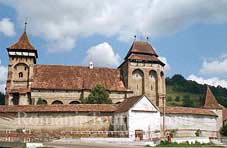
Valea Viilor Fortified Church
(UNESCO World Heritage Site)
Location: Transylvania – Central Romania
Nearby large town: Medias (8.5 miles northwest)
Nearest train station: Copsa Mica
Located in the Vineyards Valley, this fortified church was built in 1263 in gothic style and was enlarged and fortified in the 15th and 16th centuries by adding a range of 26-foot-tall and five-foot- wide walls. A unique element is the well in the center of the church choir that provided water for the locals during sieges. Inside, you can admire Saxon furniture dating from the 16th century.
Viscri Fortified Church
(UNESCO World Heritage Site)
Location: Transylvania – Central Romania
Nearby large town: Sighisoara
(25 miles northwest)
Nearest train station: Rupea
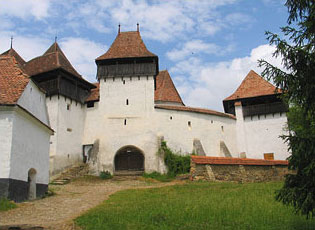
One of the most interesting Saxon fortified churches is located in the village of Viscri (Weisskirch in German). The name comes from the German Weisse Khirche, meaning white church.
Unlike other Transylvanian fortified churches, Viscri was built around 1100 by the Szekler population and taken over by Saxon colonists in 1185. This explains why this unique gothic church displays a plain straight ceiling rather than a traditional vaulted one. In the 14th century, the eastern section was rebuilt and around 1525, the first fortification walls with towers were added. In the 18th century, the church was endowed with a second defensive wall. Inside, you can admire a classic 19th century altar featuring a Blessing of the Children centerpiece by the painter J. Paukratz from Rupea. During 1970-1971, the fortified church underwent major renovations.
Main Castles & Fortresses