

Romania Tourism Romanian Travel and Tourism Information. Tourist maps and brochures.
Home           Site Map           Links           Maps           Contact Us 
Romania at a Glance Tourist Attractions Main Cities Special Interest Trip Planner About Us


Accommodation
Guide

travel map
Airfares to Romania with
Austrian Airlines

Tour and HotelDeals
travel map
Authentic Experiences
travel map Photo Album
travel map News and Views

travel map


Arts & Architecture

Visiting Romania gives you the chance to see Constantin Brancusi's works in the marvelous setting of a park in Targu Jiu, near Hobita, his home village. "The Endless Column" (Coloana Infinita), "The Gate of the Kiss" (Poarta Sarutului), "The Table of Silence" (Masa Tacerii) and "The Alley of Chairs" (Aleea Scaunelor) are displayed among trees and lawns as Brancusi wanted them to be.

Romania has a great diversity of museums preserving every facet of its history and arts. Some are small museums, catering to enthusiasts with a taste for special interests such as pharmacy, clocks, railway trains, folk arts and architecture, wine making and traditional crafts. Larger museums host regular exhibitions from around the world, as well as housing permanent collections of paintings and sculptures. Prominent museums include Romania's National Museum of Art, the Art Collections Museum, the Village Museum, the Museum of the Romanian Peasant in Bucharest, and the Bruckenthal Museum in Sibiu. For a listing of Websites offering more information on Romania's Museums, please check the Links.

Romanian Art and Architecture - Bucharest, Timisoara, Oradea, Transylvania

Romanians' vivid imagination and intense spirituality have always been expressed through their architecture. Fortunately, they also have strong preservation instincts, resulting in village museums that display bygone ways of life through found and restored peasant houses, elaborately carved gates, barns and other architectural elements. The best and most comprehensive of these is the Village Museum (Muzeul Satului) in Bucharest. Constructed by a visionary during the 1930s on a large tract within the city, this is a fascinating collection of more than 300 houses and other structures from every region of Romania. It also has a small museum and shop of fine Romanian crafts. Other such village museums well worth visiting are Museum of Wood (Muzeul Lemnului) in Campulung Moldovenesc and Museum of Peasant Techniques (Muzeul Tehnicii Populare) in Sibiu. Both have collections of early farm tools and household implements.

Monasteries, churches, synagogues, castles and palaces throughout the country, some dating from the 12th Century, depict the country's tumultuous history. Even its Communist era is expressed through Ceausescu's master planning and rebuilding of Bucharest. The best example of his testament to secularity is the Palace of Parliament — the world's second largest building after the U.S. Pentagon — whose 1,000 rooms reflect the country's best architects, artisans and building materials. Among the best examples of Romanian's Orthodox religion are the painted monasteries of Southern Bucovina, acclaimed as masterpieces of art and architecture, "perfectly in harmony with their surroundings and unique in the world for their painted exteriors." They hold UNESCO's Prix d'Or for "artistic, spiritual and cultural value." Of the five best known, the most famous is Voronet, also called the "Sistine Chapel of the East" whose blue exterior background lent its name to the color "Voronet Blue." These are essential sights for anyone interested in religious architecture, but they are only a few of Romania's architectural treasures.

Romanian Art and Architecture - Bucharest, Timisoara, Oradea, Transylvania

Romania's Architectural Treasures, by location:

Bucharest
Palace of Parliament, Cotroceni Palace, Royal Palace, Patriarchal Complex, St. Joseph's Roman Catholic Cathedral, Italian Church, Russian Church, Anglican Church, Armenian Church, Great Synagogue, Choral Temple, Sutu Palace, Mogosoaia Palace.

Wallachia
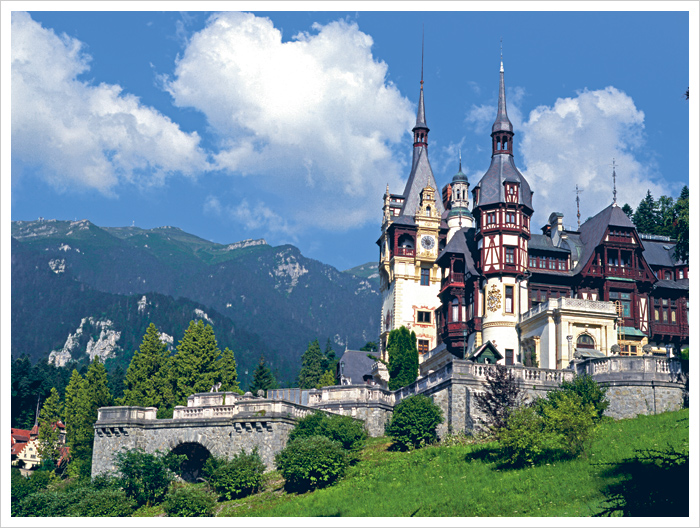
Peles and Pelisor Castles (Sinaia), Iulia Hasdeu Castle (Campina), Hurez Monastery, Dinu Mihail Palace (Craiova).

Moldova
Painted Monasteries of Southern Bucovina (Voronet, Sucevita, Moldovita, Humor and Putna), Ruginoasa Palace, Metropolitan Cathedral, Great Synagogue, Palace of Culture (Iasi).

Transylvania
Black Church (Brasov), Bran Castle (Bran), Brukenthal Palace (Sibiu), Hunedoara Castle (near Deva), Sighisoara Medieval Town, Sibiu — Old Town, Brasov — Old Town, Fortified Churches in Biertan, Harman and Prejmer.

Maramures
Wooden Churches, Wood Museum, Sighet Synagogue (Sighetu Marmatiei), Satu Mare Synagogue.

Romanian Art and Architecture - Bucharest, Timisoara, Oradea, Transylvania


Entire contents © 1998-2008 the Romanian Tourist Office
All rights reserved. RoNTO's prior written permission is required before parts of this Website may be reproduced in any form. The contents of this Website are for information purposes only and are not to be taken as endorsements or warranties of any kind. RoNTO shall have no liability for errors, omissions or inadequacies of the information contained in this Website or for any interpretations of that information.


Peles Castle - Romania
Peles Castle


Corvinesti
Corvinesti Castle


The Royal Palace
Bucharest -
Royal Palace


The Royal Palace
Bucharest -
Cotroceni Palace


Parliament Palace
Bucharest -
Parliament Palace


Cantacuzino Palace, Bucharest
Bucharest -
Cantacuzino


Iasi - Palace of Culture
Iasi -
Palace of Culture